
Mike Leigh's mooted swansong, concerning two social workers grappling with differing relationship and family woes, happens to be one of his finest films.
In a roundtable interview towards the end of July 2026, Mike Leigh suggested that his sixteenth film, Tender Loving Care, would likely be his last, not out of choice but necessity. Complications from living with the muscle wasting disease myositis have reduced his mobility, and Leigh admitted that the physical demands of filmmaking were becoming a burden.
His pragmatism is reflective of the no-nonsense attitude which is embedded into his artistic style, but also speaks to ongoing accessibility issues in not just the film industry, but British society as a whole. With social care suffering year-on-year cuts and the NHS constantly under the threat of privatisation, it’s evident that the most vulnerable are a continual afterthought, and popular cultural and political rhetoric seeks only to divide people along the lines of who is able to “contribute” to society and who is not.
In short: to exist in an ageing, disabled or otherwise vulnerable body is to be constantly scrutinised, with the constant expectation to justify one’s existence, or to be seen and treated as though invisible. These stories from the margins are often unheard, and when they are, they fail to inspire the radical change necessary to provide dignity for all.
Leigh himself doesn’t often care to openly reflect on the thematic content of his work, but it's hard to separate the art from the artist in Tender Loving Care, given that Leigh likely embarked on it with the awareness it might be his filmmaking farewell. While I hope that is very much not the case, if this is to be the final Mike Leigh film, he's chosen to go out on a spectacular high.
Working in his usual highly improvisational manner with a quartet of past colleagues, Leigh finds himself in the London suburbs again – first on a hospital ward, where an elderly patient is paid a visit by chipper social worker Rosie (Alice Bailey Johnson, daughter of Marion Bailey). She’s there to oversee his transition out of hospital following a heart attack, but finds the man unreceptive to her persistent line of questioning whereby social services treat patients less as individuals and more as exercises in filling out forms.
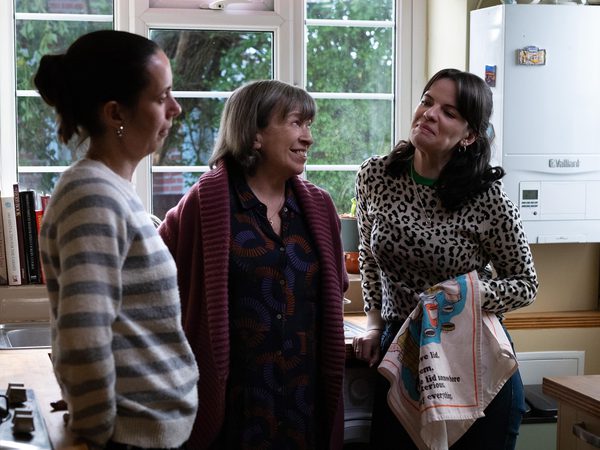
Once home, Rosie eagerly awaits the return of her best mate Amy (Kate O’Flynn), also a social worker, who’s recently broken up with her long-term boyfriend after he decided to go back to his ex. It’s evident that Amy is putting on a brave face about her relationship woes, but she’s still happy to be back in Rosie's spare room. With the same dark hair and wide, mischievous grins, they could be sisters – Amy’s parents Birdie (Marion Bailey) and Geoff (Paul Jesson) certainly don’t make the distinction when both pop round for a cuppa and a catch-up, reminiscing about the past and gossiping about the neighbours.
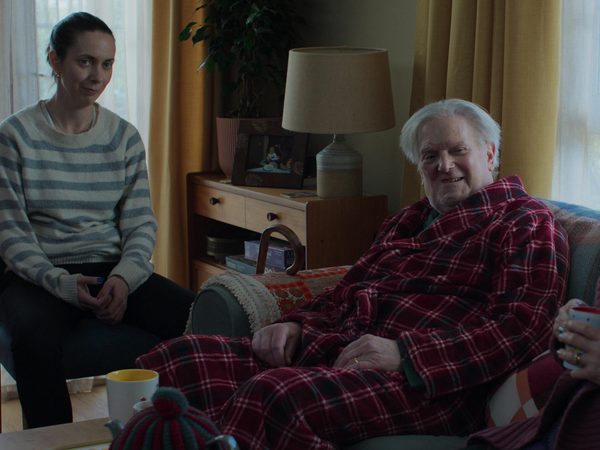
These cosy vignettes of domestic life are thrilling in their mundanity, recognisable as a shared experience for family units (biological or otherwise) the world over. Amy and Rosie sharing a bottle of white wine and dancing in their living room; Birdie and Geoff singing as they do the washing-up; this is what life is so much of the time, and rarely until that daily routine is disturbed do we really notice its true value. In Tender Loving Care, this disruption comes when Birdie begins to notice Geoff's health is declining. At first she thinks it’s a passing bug, but as Geoff struggles with fits of aphasia and growing fatigue, Birdie and Amy become more concerned, unable to name the reality they both seem to realise is inevitable.
Intermittently we see Amy and Rosie at work; both take the emotional toll of their job in their stride but lean on each other at the end of a gruelling day. Like his sunny protagonists, Leigh employs a gentle touch, sketching the frustrations of contemporary British carework without becoming didactic. He has immense faith in the audience to understand the meaning in his art, and that a portrait of a family muddling through can be much more than that. (He’s built a career on the concept, after all.)
This delicate nature follows in the central performances, from which it’s hard to pick a standout due to their collective quality. Bailey imbues Birdie with a recognisable reluctance to be a burden to her daughter paired with evident fear at what she knows is inevitable, while Jesson handles the tricky demands of Geoff’s condition in an affecting manner. Opposite them O'Flynn and Bailey Johnson are a charming double act who make it easy to buy into the long duration of Amy and Rosie's friendship – it's clear that even after decades, Leigh's process of working closely with his actors to find the story within the scenario is still paying dividends, developing characters that feel embodied rather than occupied.
There's an indisputable heaviness to the subject matter of Tender Loving Care; it creeps up on you, when Amy's trying to reason with a struggling mother who risks losing her child due to drug addiction, or when there's a melancholy edge to a loud singalong of ‘The Great Pretender’. That same sharpness that pierces through Bleak Moments and Secrets & Lies is present, perhaps most noticeably in the arresting image that ends the film, a contrast to Truffaut's iconic final shot of The 400 Blows.
Yet Leigh’s familiar bite is tempered with the warmth so often lacking in our isolated present. The inevitable sadness is met with crucial compassion, be it in the way Amy speaks to a young boy about his love of Thorpe Park as a means of relating to him, or the kindness Birdie shows to a friend who's recently lost her husband. The institutions supposed to support us might crumble and fall, but Tender Loving Care makes the case that there needn’t be a quota on humanity; to care and be cared for in a time of rampant self-interest can be a quietly revolutionary act.


0 Comments