
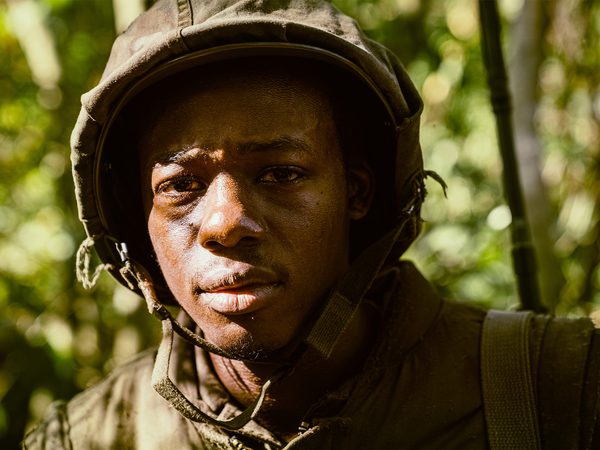
Shinya Tsukamoto's harrowing adaptation of Allen Nelson's account of combat during the Vietnam War never quite manages to grapple with the specificity of his experience.
Allen Nelson was a Black veteran who struggled his entire life to come to terms with his actions during the Vietnam War. His time in the marines was measured in atrocities; after coming home, he couldn't reconcile a domestic existence with what he did in the name of American imperialism. It was only after decades of struggling with the symptoms of PTSD that Nelson found his calling, travelling the world giving a brutally honest account of his wartime experience in a continual act of penance. In Japan alone Nelson spoke over 1200 times. The affecting title of his memoir, Mr. Nelson, Did You Kill People? is shared by Shinya Tsukamoto's adaptation, though the film struggles under the weight and implications of Nelson's confession.
Tsukamoto is no stranger to cinematic brutality; even beyond his previous war films Fires on the Plain and Shadow of Fire, he has well-documented form in horror filmmaking. As such the scale of bloodshed in Vietnam is never in doubt. Bullets rain down in sheets; limbs are ripped from sockets with impunity; a grinning sergeant cuts the ears from corpses to hang as trophies around his neck. War is hell and Nelson (played in his youth by Mark Merphy, then later by Rodney Hicks) an active participant, despite showing more reluctance than most of his fellow marines. Years later he recalls his experiences to his therapist (Geoffrey Rush) with the goal of eventually being able to stop taking the medication he uses to ease his symptoms. At home his wife Linda (Tatyana Ali) is understanding but frequently frightened of his violent outbursts; it's clear that Nelson's entire future hinges on his ability to work through his trauma.
Ironically, Nelson ultimately finds that his method of working through his experiences is to share them with others. In one of the film's more effective scenes, Nelson recounts these experiences with his son Sean's high school class; Tsukamoto shoots the moment in slow motion, forgoing the specifics of Nelson's speech in favour of a piercing sound that conveys appropriate shock and disgust.
Yet the film fails to grapple sufficiently with a crucial aspect of Nelson's story: his identity as a Black man in Vietnam at a time when America was still mostly segregated. Only one reference is made to this detail, when Allen and some other Black marines kill a Vietnamese soldier and he asks why they fight for a country that won't let them be free. The complexities and contradictions of Nelson's identity feel underserved, and there's no sense of the specificity at play in this particular narrative. Instead Tsukamoto relies on the shock and awe of placing us in Nelson's shoes, while needling at the question of individual responsibility in a war. This feels like an incomplete story, and while one gets a sense of the lifelong guilt and pain Nelson felt about his actions in Vietnam, there's little in the way of character beyond this, no dimension given to him beyond his trauma, or to the individuals who make up his family.


0 Comments