
A decade since the first series of Phoebe Waller Bridge's opus aired and defined the modern tragicomedy, we remember it for its take on screwing things up.
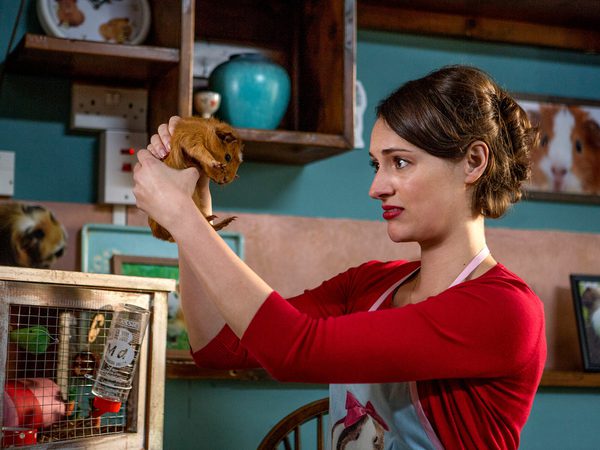
There’s a joke in the premiere of Fleabag that’s stuck with me ever since it aired on BBC Three ten years ago. The titular mischief-maker created by and played with ferocious candor by one Phoebe Waller-Bridge meets with a bank manager (Hugh Dennis) in the hopes of attaining a loan for the guinea pig-themed café she operates. She’s nervous and drenched in sweat from running late; not really noticing, the manager sheepishly mentions the bank’s recent sexual harassment scandal. How do these details converge? As he flips through her application and says there are “one or two more bits and pieces [he’s] going to need to see some more of,” Fleabag reaches to take her sweater off, forgetting she has no undershirt on, and accidentally flashes him. He deadpans, “That kind of thing won’t get you very far here anymore.”
It’s the kind of gag that comedies thrive on, combining visual surprise with delicious wit in a way that arouses both schadenfreude and genuine empathy from a viewer. But Fleabag’s ambitions went beyond mere sitcom hijinks, aiming for something more raw and authentic. The misunderstanding here puts Fleabag on the defensive, leading her to insult the bank manager and blow her chance for the loan she so desperately needs. It’s a grim, pitiful display, and the sort of blunder that, we come to learn, is rather typical of her. That’s because as much as the series covers a broad range of topics – how grief feeds loneliness and vice versa, the incongruities of female sexuality and feminist ideology, how brilliantly loathsome national treasure Olivia Colman can be – Fleabag will always endure as a show about mistakes: how we make them, why we make them, and how we can ever come to forgive ourselves and others for making them.
Fleabag was both an anomaly in the TV circuit and part of a larger movement when it premiered in 2016. Adapted from Waller-Bridge’s one-woman play, which debuted at the 2013 Edinburgh Festival Fringe, it was arguably one of the key works that helped usher the word “tragicomedy” into the mid-2010s cultural lexicon, alongside other projects such as Louie, Transparent, You’re the Worst, and Bojack Horseman, to name a few. These were incisive, character-driven shows about damaged yet funny people trying to navigate the complexities of life while deriving some sort of larger meaning from their pleasure and pain. The first season of Fleabag, too, seesaws on the spectrum of hilarious to heartbreaking. With its provocative embrace of an aspirationally feminist character as salacious and outrageous – but also, critically, “unseemly” and at times challenging to “root for” – Fleabag the character made Fleabag the show an outlier among its contemporaries. An antiheroine successor to Chewing Gum’s Tracey Gordon and precursor to This Way Up’s troubled Áine, this type of multidimensional female character was nevertheless seldom portrayed when the show premiered, and is seldom portrayed now.
In the first episode, Fleabag-as-narrator initially presents as a woman in control of her own story, the type of cosmopolitan best friend you might grab a raucous, profanity-laden brunch with, then go home and secretly worry about. Sure, she goofs up: she beds some subpar candidates thanks to a voracious sexual appetite, gets into passive-aggressive cold wars with her godmother (Colman), and consistently vexes her control-freak sister Claire (Sian Clifford), even smacking her in the face when confusing her attempt of a hug for an attack. But with her curlicued bob and knowing smirk, she flicks her eyes toward the camera to confide in us directly, sometimes to contextualize the situation at hand, but more often to tell a dirty joke, express some level of disgust, or share something intimate she can’t manage to utter to the actual people in her life. In other cases, she whips us from one scene to the next, the editing sometimes slicing a joke off mid-punchline or carrying with it a tint of the surreal. While these moves may ostensibly be read as televisual “errors,” they work to suggest that Fleabag’s agency expands beyond the parameters of her life on screen – but also, maybe, that we’re not getting the full picture of who she is or what she’s done.
Eventually, the mistakes Fleabag makes and their ripple effects accumulate in a way that hints at something else: maybe these aren’t all “honest” mistakes after all. Indeed, there’s something darker lurking underneath this compulsion for theatrics, a masochistic streak meant to scratch the itch that tells her she’s a “greedy, perverted, selfish, apathetic, cynical, depraved, morally bankrupt woman who can’t even call herself a feminist.” A wickedly funny early scene finds Fleabag getting caught masturbating to a speech by then-President Obama (God, how I miss the before times) by her sensitive yet doofy boyfriend, Harry (Hugh Skinner). It leads to their not-so-funny breakup (even after Fleabag proudly informs us, “He’ll be back”), and when he asks if what she really wants is to be alone, it’s one of the few instances Fleabag doesn’t make a droll aside; in fact, she doesn’t say anything at all.
However, it’s not until the season finale that we learn the most significant source of her pain. Throughout the season, tender flashbacks depict Fleabag sharing laughs and bona fide intimacy with best friend Boo (Jenny Rainsford), whom Fleabag has informed us died by suicide, albeit an accidental one – another grim miscalculation. Her grief over Boo’s death is palpable, yet Claire is the one who reveals why it’s sent Fleabag into a debilitating spiral of shame and self-destruction when she brutally alleges that Fleabag sleeping with Boo’s partner was the catalyst for her death. It’s Fleabag’s greatest and most horrifically permanent mistake, and in confirming her worst suspicions of herself, it recontextualizes all we’ve seen thus far. As the camera narrows in on Fleabag from all sides, she can’t even escape judgment from her new fourth-wall confidants.
Fleabag’s fateful mistake – brought on by the grief over her mother’s death, an unhealthy obsession with sex, and a laundry list of other possible afflictions – is the type of reveal that could be some viewers’ final straw (Tony Soprano and Walter White could murder a small village without losing a single fanboy, of course, but being the “other woman” is plain unforgivable!). And while Fleabag the character leaves the interaction shattered and aimless, Fleabag the show knows exactly where to go from here: shortly after Claire’s confrontation, a chance encounter with the first episode’s bank manager, of all people, finds him and Fleabag sitting together in her and Boo’s café. With mascara streaming down her face, she unloads all her misdeeds onto him: “I fuck everything,” she says, the double entendre too severe to find funny in the moment. He leaves, returns from his car with her rejected loan application, and decides to redo their botched interview. Why? Because, as he says, “People make mistakes”.
Even after its stellar second season (and the slew of Emmys and BAFTAs it’s garnered), this scene remains the legacy of Fleabag to me: ambiguous, painful, yet ultimately merciful. For as complicated a character as Waller-Bridge made Fleabag to be, it takes a simple act of grace from a stranger to remind her, and us, that while some mistakes can’t be undone, it’s all a part of being hilariously, tragically human.


0 Comments