
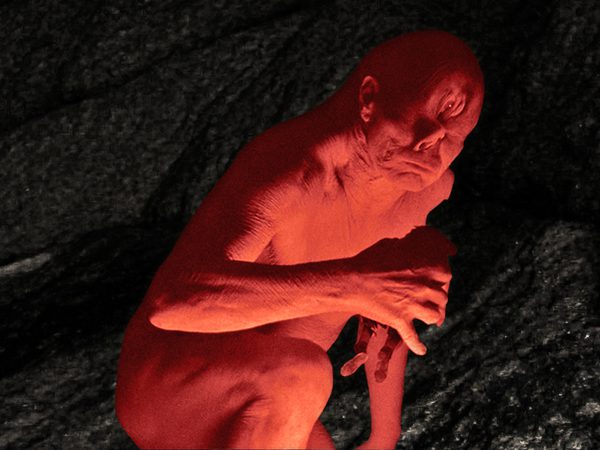
Cinema has spent 120 years trying to crack the Cyclops. Christopher Nolan finally found the answer – and it was staring everyone in the face.
Christopher Nolan's The Odyssey is so stuffed with technical triumphs that singling out one feels a little like complimenting Poseidon on his puddles. The world's largest operational Viking ship replica! The first film photographed entirely on IMAX! A strapping, 3.5-tonne stallion of a Trojan Horse! All remarkable. All very Nolan. But his most unlikely filmmaking feat? Making the Cyclops feel real.
Polyphemus has had a tough time of it – especially on the big screen. A bit of dodgy design here, some cut-rate CGI there. He needs to look impossible, yet believable. Sadly, most of the time, the one-eyed giant ends up tumbling out of his cave and straight into the uncanny valley. Nolan, however, practically and predictably approached the classic monster a little differently, taking a sideways look at Cyclops design – literally.
But before we get to that, we must survey the ghastly graveyard of Cyclopes that came before Nolan, because cinema has produced some howlers. Many of the worst offenders, admittedly, don’t even bear the Polyphemus name. Among them, Tyson, the half-brother of Percy Jackson, who looks like a bad Photoshop job in every adaptation of the book series, and Rell, the plasticine-faced fiasco from 1983 sci-fi fantasy curio Krull.
Even bigger budget efforts, such as Wrath of the Titans, struggled with the challenge. For that film’s Cyclopes, visual effects studio Framestore used performance capture of former rugby player Martin Bayfield to nail the physicality. “But, when studying human eyes, it became immediately apparent that they don’t work as singular entities,” says Mark Wilson, Framestore’s global head of CG. “Early on, we experimented by taking videos of our faces and merging the eyes together. Although the results were quite horrific, they were very informative regarding structural changes. But fitting the nose around the eye was tricky, as there was nowhere for the bridge to go.”
“The further the design moves away from human eyes, the more creative freedom you have with movement and performance,” Wilson adds. The trade-off, however, is that the more abstract a monster becomes, the harder it is for audiences to connect with it. Such was the issue faced by Olympus, a one-and-done Syfy series from 2015. Its Polyphemus had a single eye that emerged from the monster’s mouth – a fairly effective design, but one that looked more extraterrestrial than mythological, and lacked the ability to convey any expression or emotion.
For BBC’s Atlantis, Vine FX got much closer. Rather than sticking a solitary eye onto an otherwise human face, Matt McKinney and his team tried a variety of designs. “With a normal nose in place,” he says, “the creature looked inherently comical.”
“We wanted something more horrific and anatomically believable,” he adds, “so we created a Cyclops whose face looked as though the two halves had fused together. Making the nose area less symmetrical also made it feel more unsettling and believable.” This “split nasal cavity” points towards the same breakthrough Nolan would later arrive at: stop forcing a human face onto something that was never human to begin with. Instead, The Odyssey serves up a deceptively simple Cyclops design, one that no filmmaker has thought of since Georges Méliès first put Polyphemus’ single eye on the big screen in his 1905 silent short, The Island of Calypso: turn it sideways.
The result is weirdly, wonderfully convincing. Side-blinking and slow-munching, Nolan’s Cyclops benefits also from sheer scale (he stands around sixty feet tall) and a malformed nose twisting around that eye. It’s a look that Debbie Felton, professor of classics at UMass Amherst, says could be “an allusion, whether intentional or not, to congenital birth defects such as cyclopia – which include a deformed nose.” Because it resembles the logic of real anatomical abnormalities, Felton argues, the design feels more believable than previous Polyphemuses. “It’s why Nolan’s sideways-nosed, sideways-eyed Cyclops seems more organic and real than many others. But Nolan himself hasn’t mentioned anything along those lines,” she adds. “Only the Goya connection.”
That connection is Francisco Goya’s Saturn Devouring His Son, a painting repeatedly referenced by both Nolan and production designer Ruth De Jong. “That was very much the inspiration,” Nolan told L.A. Times. “We had it up on the wall. Whenever we brought in a new technology that was the first thing we showed them.” And plenty of technology was used to bring this Polyphemus to life, from a true-to-size on-set model and animatronics to, crucially, actor Bill Irwin. Previously responsible for voicing and puppeteering robot TARS in Interstellar, Irwin provided both the voice and likeness of Polyphemus. In this way, Nolan didn’t just create a Cyclops; he created a character.
It’s a practical lesson creature designers learned long before CGI arrived. “I always felt that Ray Harryhausen’s stop-motion animation was so much creepier and more effective than CGI,” says Felton. “Just more tangible and eerie.”
Harryhausen’s Cyclops, from The 7th Voyage of Sinbad, went full monster mode, adding a rhinoceros horn (a design recently riffed on in Shazam! Fury of the Gods). But its tactile nature still steered it clear of the uncanny valley — as indeed did the version seen in the 1997 television miniseries, produced by Hallmark, for which Jim Henson's Creature Shop created a full-body puppet.
Nolan, speaking to The Associated Press, has also thanked Guillermo del Toro, who told him that “a monster is never just a monster,” and that he should find “the soul of the Cyclops”. For that, Nolan says, he “needed a performer”. Irwin, whose face is clearly visible beneath the monstrous design, gave him just that. In turn, Nolan gave Irwin props to work with; Hamer FX made small semi-edible men for Irwin to munch on, complete with internal skeletons and burstable blood bags. Much of what you see on screen is practical. That’s even Irwin’s voice.
Amanda Potter, co-editor of Ancient Epic in Film and Television, believes that the fact that this Cyclops can speak is even more important than his distinctive facial features. “I do find the twisted face a bit strange, though it does work as monstrous. But the Cyclops does speak,” she adds, “which maybe makes him sympathetic. That works in the film as I think Odysseus starts realising his own arrogance after the cave sequence.”
That cave, too, was a real location in the Peloponnese region of Greece. But this is the Nolan way, doing things for real. So it’s no surprise that he resisted plonking a shonky CGI eye in the middle of an actor’s scaled-up face in favour of doing things properly. He’s a practical problem-solver, after all. As it turns out, the Cyclops solution was surprisingly simple: give him a voice, make him tangible, and when it came to that fiddly face design, simply turn the problem on its side.


0 Comments