
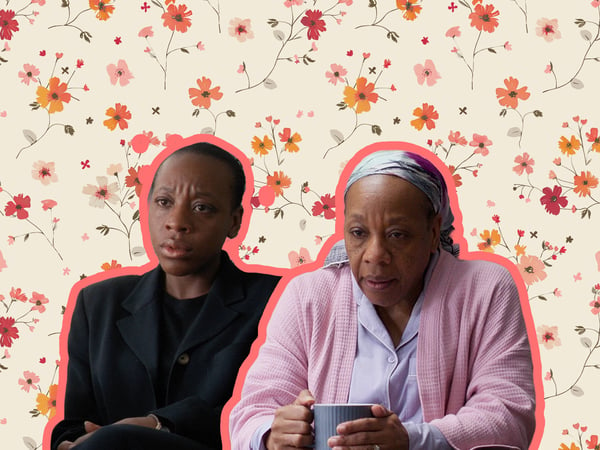
As Secrets & Lies turns 30, we look back on Jean-Baptiste's world-class collaborations with Mike Leigh.
We first see Hortense Cumberbatch, played by Marianne Jean-Baptiste, in the opening sequence of Mike Leigh’s Secrets & Lies (1996) attending the funeral of her adoptive mother. 28 years later, halfway through Leigh’s Hard Truths (2024), Pansy Deacon, played by Jean-Baptiste, visits the grave of her mother with her sister Chantelle, played by Michelle Austin. These losses have a profound impact on both women – Hortense decides to search for her birth mother, while Pansy is traumatised into a deep reclusion and depression. They live in a degree of isolation, the former largely content with her independent and stylish life as an optometrist, and the latter dissatisfied with pretty much everything.
Given the range displayed by Jean-Baptiste in these roles, both created with and directed by Leigh using his characteristic improvisational process, it is unfortunate that she has not enjoyed a career in the spotlight. The year after Secrets & Lies screened at Cannes, she made headlines for calling out the fact that she had been excluded from a group of young actors invited to a British Screen event at the festival, criticising “the old men running the industry” who believe that Britain is a “totally white place where people ride horses, wear long frocks, and drink tea.” Hortense was only her second film role, following a small part in Hanif Kureishi’s London Kills Me (1991), yet she was nominated for supporting actress awards at the Oscars, the BAFTAs, and the Golden Globes. This opened the door to Hollywood, but never in the lead role.
Jean-Baptiste finally top-billed another British film in 2018, Peter Strickland’s In Fabric, in which she played a divorced bank teller called Sheila Woodchapel. Like Hortense, she is a poised and quiet woman who decides to take back control over her life, in this case by venturing to a department store in search of a new dress. The scarlet garment she acquires is intoxicating, quite literally, as the frock is revealed to be cursed. In the early scenes of the film, the camera closes on Jean-Baptiste’s face, her eyes darting towards the floor, a slight enigmatic smile masking a complex inner world – the suppression of desire and agency.
It is a manner seen throughout Secrets & Lies, also a quiet performance conveyed largely through subtle facial expression. Even when Hortense is emotional, as when Lesley Manville’s social worker first reveals the identity of her birth mother (Cynthia Purley, played by Brenda Blethyn) she cries in silence. Others do all the talking, incessantly, around her, while Hortense sits in the middle taking everything in. Manville’s hapless performance is a precursor to the extreme contrast between the characters played by Jean-Baptiste and Blethyn, the former’s dialogue clipped to brief sentences and one-word responses, while the latter’s nervous chattering is only interrupted by caesurae of “sweetheart” and “darlin’”.
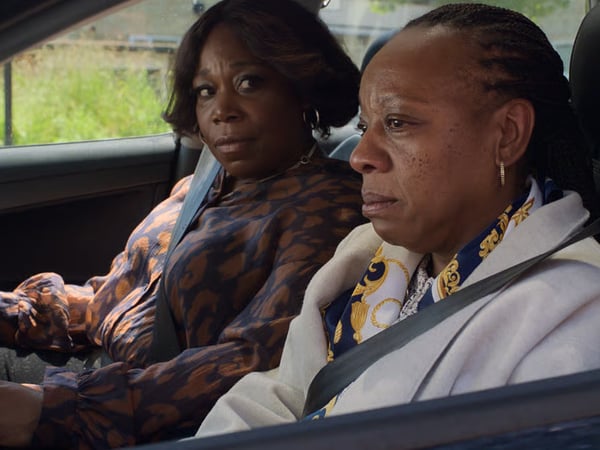
Cynthia bawls, Hortense holds herself together, at first over the phone and then in person. The camera holds mother and daughter in a long shot outside Holborn station, tracking Hortense as she paces past Cynthia without recognition. Then to an uninterrupted take in a café, the women sat side-by-side, eyes moving everywhere except to each other. Cynthia says she cannot be her mother because she never slept with a Black man, before an overwhelming look of recognition comes over her and she starts to weep. We never do find out who that man was – “Oh, don’t break my ‘eart, darlin’” she whines when Hortense later asks if he was a nice man. It is no wonder that Blethyn was awarded for her performance, at the BAFTAs and at Cannes, for it is a more obvious, dramatic performance than that given by Jean-Baptiste. Yet it is her quietness which makes this scene so potent, her extraordinary patience and composure in reassuring the mother who let her go that she should feel no shame for what she did. At the end of the scene, Hortense recalls being told that she was adopted by her mother on a flight back to England from Barbados. “I just looked out at the clouds,” she says.
Pansy bolts upright with a shout at the beginning of Hard Truths. She goes to the window and looks through the curtains fearfully at the pigeons outside. She shouts at her son Moses, chastising him for filling the kettle with too much water and for going for walks. At dinner with Moses and her husband Curtley, she launches into a tirade: first against “grinning, cheerful charity workers begging you for money for their stupid causes”, then a neighbour who dresses his dog in a coat and boots (“Why has the dog got on a coat? It’s got fur, innit?”), and a local mother who parades around with her daughter in an outfit (“What’s a baby got pockets for? What’s it gonna keep in its pocket? A knife?”). “I love babies,” says Hortense wistfully to Cynthia in Secrets & Lies, glancing gently downwards conveying a wish for a life not yet lived. The change of volume in Jean-Baptiste is striking, immediately asserting that this film is no extension to the character she had played before.
There are parallels to be drawn between the two films, largely in the exploration of contrast within a single family. Chantelle clearly adores her daughters, and their flat is filled with laughter and life, compared to the silence and fear in the Deacon household. Hortense clearly lived a cultured, middle-class life away from the loud tensions of the Purleys – “Welcome to the family,” jokes Cynthia’s brother Maurice, played by Timothy Spall, to Hortense after his niece’s birthday barbeque goes up in smoke. Both films hinge on such a dramatic dinner scene. In Hard Truths, Pansy agrees to go to Chantelle’s flat for Mother’s Day after she has admitted to her sister that she wants everything to stop and that she is frightened. “I don’t understand you, but I love you,” her sister says, making clear that she acknowledges that there is a tumult of complexity brimming away under Pansy’s rage.
Like Hortense at the barbecue, Pansy sits in silence and stares at the floor. Yet here Jean-Baptiste is conveying an anxiety, one which builds into hysterical, maniacal laughter when Moses tells her that he has bought her a bouquet of flowers. It gives way to sobs, louder and more primal than any of the tears shed by Cynthia in Secrets & Lies. The camera moves to everyone around her, in the same stunned silence of Hortense, before returning to Pansy’s soaked face. It is an overwhelming eruption of emotion, one instantly recognisable to anyone who has suppressed a long-term depression, which is at once both frightening and utterly heartbreaking. It feels like an apotheosis, and certainly a catharsis, to Jean-Baptiste’s career.
Hortense is polite, almost too polite, while Pansy is truly detestable in her manner with everybody. By the end of Secrets & Lies, Jean-Baptiste’s poise is much more relaxed, chatting with her newfound sister Roxanne, played by Claire Rushbrook, with whom she plans to go to the pub. There is not a hint of snobbery on Hortense’s part in her relationship with her new family which makes her extremely endearing. Pansy also starts to change, opening the French doors at the back of her house and breathing in the fresh air. She fills a vase and cuts open the flowers, visibly anxious of doing so and yet she manages it. They are small steps towards liberation from the guards she has built up around her. This cinematic diptych shall surely be Jean-Baptiste’s acting legacy, and while it would be wonderful to have seen her more on this side of the pond, few actors ever reach the command of nuance, subtlety, and inner complexity she displays.


0 Comments