
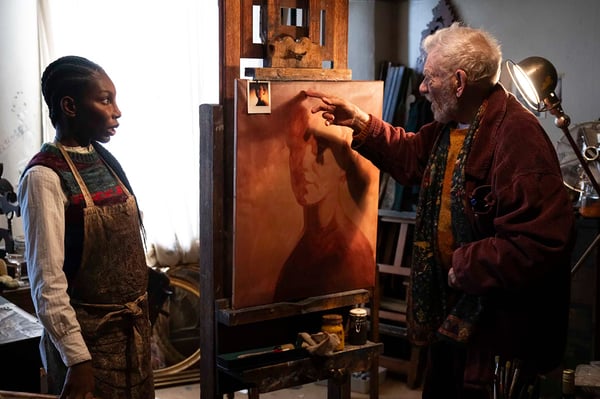
Steven Soderbergh's latest film focuses on a revered artist – the painter and production designer tasked with creating his fictional oeuvre reveal their secrets.
How can you tell that a painting is the work of a great artist? In Steven Soderbergh’s The Christophers, art restorer Lori Butler (Michaela Coel) is enlisted in a scheme to forge a series of portraits by Julian Sklar, a renowned painter of the pre–Young British Artists generation. The first and second series of the “Christophers” (named for their young subject) sell for millions, but Sklar abandoned the project in the 1990s. A third, unfinished batch of Christophers languishes in his attic, awaiting a buyer – if Lori can pass them off as the master’s work.
As Lori secures a position as Julian’s assistant, their conversations, and her assignment, touch on questions of authenticity, originality, authorship, and genius. These were also questions for Antonia Lowe, production designer of The Christophers, and Barnaby Gorton, a scenic painter who has contributed in-world portraits for films including the Harry Potter series. Like Lori, they were tasked with creating paintings that could plausibly be work in the style of a major talent: both eight evocative and unfinished Christophers, and (this and the interview that follows constitutes a spoiler) their eight finished versions, completed by Lori after Julian’s death, which are wild and extravagant, and, though attributed to Julian, are considered a bold departure from his style. Lowe and Gorton refer to Julian’s unfinished Christophers as “Stage One” and Lori’s continuations as “Stage Two” throughout our conversation.
LWLies: What was the brief for the Christophers paintings?
Antonia Lowe: The initial point was thinking about it as a whole. The studio and the artwork had to tie in together, so [we were] looking at artists who felt authentic to the time period. People like Lucian Freud and Francis Bacon [are] probably the most obvious but clearest reference points as London artists of the time when Julian Sklar would have been working. [We] took references from their studios, but also some of the processes that go into their painting style, in putting mood boards together.
One main point was trying to find an artist early on – we had very little prep time, and actually very little shoot time. Steven’s incredibly quick. I think we had five weeks’ full prep time for a three-week shoot, and the paintings would be seen right at the beginning of the shoot. We needed to ensure that we were happy with the person stylistically, but also that they were able to work within film timetables.
We had chats in the beginning about colour palettes and tones, and mood boards were shared with Barnaby so he got a feel of who Julian Sklar was in the whole. We tried to feed you as much of the world as possible.
Were Soderbergh or [screenwriter Ed] Solomon hands-on? Were you showing them sketches?
BG: In the first stage, there was no hands-on. It was, “We need these in various stages [of completion].” We did them in a week. That’s great, when you’re working at speed, because you don’t get caught up in the detail. We did 16 paintings, so Steven could choose the eight, and the extras went on to become the second stage paintings. Two of each image, because we were given eight Polaroids [of young Christopher, which are affixed to the Stage One canvases in the film].
AL: Stylistically, the Polaroids set the tone. That casting process had to happen quite quickly, to get the actor who was going to be our young Christopher. And [there were] discussions with Barnaby, but also with Steven, thinking about the framing and how these Polaroids were lit. The main point was making sure that it felt like Christopher, as a subject, was at the front and center – not to have any detail in the background, for it not to be like a [David] Hockney, where you’ve got the person within their space, or within a space. To have that void, so that the full focus is on the face and the expression, and everything else is blurred out, giving it this sense of importance, so every detail is looked at and considered.
Barnaby, the way that you translated those Polaroids into your initial sketches and paintings was great because it was quite immediate, you went for it in a reactive way.
BG: Some had a white background, some had a dark background – I just wanted to give [Soderbergh] a choice. So they were worked up, but they were, at the most, four hours each; if he hadn’t liked them, I could have overpainted and started again.
Second stage there was a lot more input in how mad it got. The second stage was [initially] much more figurative, and more how I would see he would have completed [the paintings] at that time. And then Steven went, No, no, no, we want a lot more paint.
AL: I think he said “Wilder.” And we were like, “Oh, OK.”
BG: Then we had them all lined up and went through each painting. Which one do you want paint thrown on? Which one do you want slashed? Let’s have a big mark here. It was great to then go back and not be afraid of slashing and burning and all these other things. That was quite freeing. I enjoyed that a lot.
AL: Steven’s got it so much in his head, in terms of the blocking. He knew what he wanted in terms of the emotion and the movement that Ian [McKellan] would have to give [when desecrating one of his unfinished Christophers, thus inspiring Lori’s continuations]. So [Stage Two] was slightly reverse-engineered: We had to come up with a finished piece based on the movements he wanted from the characters. He wasn’t too prescriptive in terms of exactly what they looked like, as long as he had the ability to manipulate the movements in the way that he wanted, and to give Ian McKellan the space to make it funny, expressive, all of those things that it is onscreen.
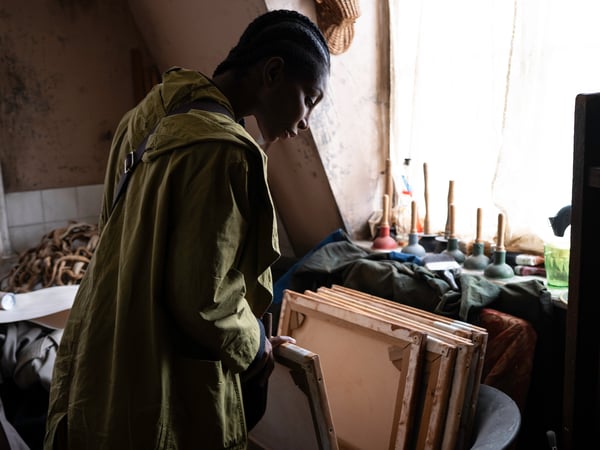
For all the scenes when Julian or Lori is slashing a canvas or splattering paint, are those your paintings?
AL: We had what we called the “hero” ones, if you were going to really see it, and the ones facing away are prints. We photographed them, so that [the actors] could slash them. We printed some onto the same canvas, used exactly the same method of the pins on the sides – the prop team did that – and then Barnaby aged the backs of them so that they all looked exactly the same.
It’s a significant plot point in the film that the Christophers were made with specific deadstock art supplies, and Lori also talks a great deal about how many layers of underpaintings Julian did in each previous Christophers series. Was there any effort to replicate the process or the materials that are described in the script?
BG: In the second stage, yes, because you have the scene where he’s got pink paint on his hands and then wipes [the canvas] down.
AL: In terms of Stage One, Ed had written certain things into the script, and we tried to replicate some of what he was talking about in terms of the lines, but that description given by Michaela is about series one and series two [of The Christophers]. I thought that on series three Julian probably hadn’t even got to the point of layering, because he got this block. So it was important to keep them quite raw, to get across the idea that he’d started but very quickly couldn’t bring himself to go further with them. I guess we just have to imagine what series one and series two are like, although there’s a very good description in Lori’s monologue.
BG: Stage One, if you were doing it for yourself, that’s how you would approach it, you would have given the background a color and then worked over the top with your initial drawing. And that’s all it was, really, that initial drawing. It’s not even the beginning that Lori’s talking about [in her monologue], it’s all mid-stage painting, when you’re building up the background tones, letting the temperature of those colors work through the cooler temperatures you put on top.
The colors of the series three Christophers are interesting – there’s a lot of ochre, which, as Lori says, Julian had called a sentimental shade. It also reminds me of the sepia tint of old photographs.
The sepia tones were there in the Polaroids, which was very much to get that sense of nostalgia, that feeling of warmth at a point in [Julian’s] life – something beautiful that had been lost.
For the Stage Two paintings, you’re working with shredded canvases, with glue, feathers, bedazzling – what references were you working with for Stage Two?
BG: All extremes, really, from Pop Art to Abstract Expressionism.
AL: There was a real mix of people – sometimes you don’t want to look at too many reference points because you want it to have clarity, [but in this case] they had to be so unrecognizable from his previous style that each one had its own identity.
One interesting thing about this particular project is that Julian Sklar is, by reputation at least, a great artist. To put it bluntly, were you thinking about how good the Christophers were supposed to be?
AL: With Stage Two, it just had to be a departure. With Stage One, there is a pressure point to make sure that they felt that they could be from the hand of a great – but then, they’re not finished. So you needed to have the essence of those skills, like Barnaby has, but not to take them too far.
In [Julian’s] house, we couldn’t have his work [because the character had sold off all his work earlier], so you couldn’t see any of his paintings. Knowing what artists are like, usually they’ve got stacked paintings all around the studio and you can get a sense of their style. You only saw a little bit; we used other artists, hiring finished work that was similar to the style of Barnaby’s Christophers.
BG: To compare yourself to the greats is a mind warp, really, because how can you compete? Many people spend the whole time in art school worried about how good they are and then don’t get on with doing any work.
This film is concerned with authenticity versus imitation, genius versus mediocrity, forgery versus originality. Those are themes, but also you two have a job to create work in a recognizable style, just as Lori does. Soderbergh has signalled an openness to working with generative AI in other of his films, so I’m curious, in a very open-ended way, if you have thoughts about where or whether AI fits in your own practice.
BG: AI produces extremely polished mediocrity. There’s nothing new in there. The one thing AI does not do is recognize a good mistake. Often, when you’re painting, you make a mark, and you leave it. This is how you build up your paintings. And then sometimes you get rid of it because it’s not working further down the road.
The times I’ve worked with AI-produced imagery for paintings, they’ll miss out on major mistakes. I was doing a portrait for Wolf Hall, painting the main actor, and I had to put the lines back in his face because AI had taken them out.
When digital printing of artwork came in, a lot of us said, Well, we’re ruined now. But actually, people want original stuff on their walls – otherwise, just buy a poster.
AL: It’s a tool, it shouldn’t be used as a finished product. That comment you made, Barnaby, about mistakes: I’ve seen people use AI for pitch decks – and I can only speak of my own experience as a production designer; people will use it in different ways depending on their job – but what AI takes away is any of the happening upon something. It’s a bit like when you use a search engine, as if I was to only do my mood boards by going onto Google, or searching through Pinterest, compared to if you go to an exhibition, you walk around and happen upon things. Wow, that red, or that shape, or the way that person’s painted the ceiling. AI doesn’t allow for any of that to come into your work in an organic way.
I think where it can be used, which I think is what Steven’s talking about, is as a tool. Within filmmaking, we’ve had processes change. We’ve gone from painted backings that we used to use for sets, to printed backing, to translighting, to sometimes now using the volume stage. So I see it as part of the process, but it can’t be the entirety of it and never will be able to be. Personally, in terms of fine arts and crafts, I think the way it will go is that people will value the handmade more than anything else.


0 Comments