
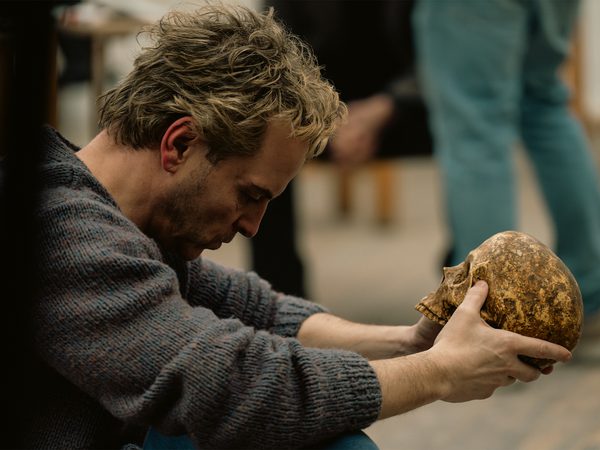
Andrew Scott has his eyes on the prize as Ian Charleson, the British actor who played Hamlet at the National while fighting an AIDS diagnosis.
I never went to film school, but I know from friends and the dripfeed chatter of academic folk tales that the first lesson you learn on the first day, one that becomes a mantra to all budding future filmmakers, is this: don’t ever make a movie where Derek Jarman is the bad guy. It’s just not a good idea to represent Jarman – arguably one of the most important, perspicacious and profound artists of the 20th century – as anything less than a glowing Earthly sage. Alas, in Simon Stone’s Elsinore, Jarman is bussed in as a catty, overzealous foil to the closeted star of Chariots of Fire, Ian Charleson. Around the mid-point of the film, the pair descend into a fiery dialogue about the value of going public with their AIDS diagnoses, and it’s very clear which side the makers of the film are on.
Indeed, everything about Elsinore is designed to elevate Charleson, from Steven Beresford’s witty script, Stone’s aggressively sentimental directorial treatment, and most of all, Andrew Scott’s central performances in which he simply cannot stop emoting. This is not to diminish the astonishing feat of Charleson’s operatic swansong – playing Hamlet at the National while undergoing daily treatment for his worsening condition – yet the film’s decision to wear its hagiographic intentions on the sleeve of its blood-flecked blouson doesn’t leave much room to ponder any deeper philosophical ramifications behind Charleson’s decision.
It opens with Charleson feeling the itch of failure – he recites Shakespeare during sound tests for auditions in crappy genre films for which he has no real connection. And he’s very fed up with the rictus smile he’s forced to flash every time he hears the iconic Vangelis theme song from Chariots of Fire. This eye-rolling haughtiness is played for laughs initially, but becomes wearying when everyone he encounters is a dilettante or an oaf, even his seemingly-friendly GP who is chided for [checks notes] washing his hands.
By strange coincidence for the Bard-loving thesp, Daniel Day-Lewis is in the papers having walked out of a glitzy run of Hamlet at the National, and its director, Richard Eyre (Johnny Flynn), targets Charleson as a replacement. Ian sees this as an opportunity to seize the glory of ambition and performance and end his life fulfilling a sizeable professional dream. He’s open with Eyre about his situation and – presumably due to the fact that so little was known about HIV/AIDS at that moment – the director decides to keep things mum (I’m sure the insurers were thrilled!) and the world’s longest script-learning training montage begins.
Elsewhere, Olivia Colman isn’t given much to do as pioneering AIDS doctor Margaret Johnson, while Billie Piper is acting in a different film as Charleson’s casting director friend, Patsy Pollock. Flynn is low-key great as Eyre, while Monica Dolan is on film-stealing form (again) as the dryly witty, chain-smoking stage door manager at the National. It’s by no means a bad film – it’s stuffed to the gills with memorable barbs, and it certainly means well. Scott’s performance, too, is impressive if you go for that all-in thesp bluster where every nuance, every expression is precision-tooled and wielded for effect. Yet it’s so violently focused on tapping the tear ducts, attacking you from all flanks, that – unlike Charleson's Hamlet – it actually ends up coming off a little cold and studied.


0 Comments