
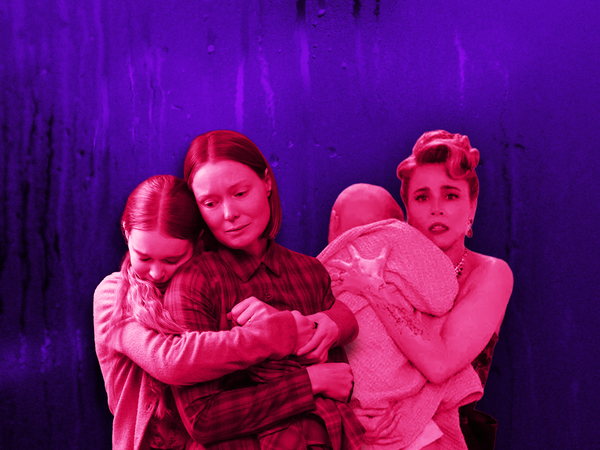
As the wider shift towards conservative values champions increasingly restrictive ideals of femininity, how can the "monstrous feminine" transform female rage into rebellion?
Horror has long relied on the archetype of monstrous femininity to explore violent resistance to societal norms, often exposing and even perpetuating the conditions that make such retaliation seem necessary. Coined by Barbara Creed in 1993 to describe what makes women “shocking, terrifying, horrific, abject,” the monstrous feminine is a key frame through which we examine how horror cinema constructs women’s bodies, sexuality, and reproductive functions as sources of fear, and poses a challenge to us as viewers to question whether the trope can be objectively read as empowering, or as a derogatory hindrance.
Brian De Palma’s Carrie, which celebrates its 50th anniversary this November, remains the most influential depiction of the monstrous feminine. De Palma’s adaptation of the Stephen King novel depicts a God-fearing yet deeply repressive America that bears striking similarities to the country we see today. Amid resurgent conservatism, closer church-state ties and renewed debates over female liberation, Mike Flanagan’s eight-part adaptation arrives at a particularly timely moment. Alongside Crystal Lake – the Friday the 13th prequel exploring Pamela Voorhees’ (Linda Cardellini) evolution into a murderous mother – both series invite us to consider how shame, repression, social exclusion and grief shape rage, with Crystal Lake taking the edge in terms of its execution.
Paying homage to De Palma, Flanagan fuses the supernatural with modern life. Summer H. Howell’s Carrie White is a vulnerable, curious young woman raised off-grid by her fanatically religious mother, Margaret (Samantha Sloyan). Following her father’s unexpected death, Carrie is forced to attend public high school for the first time, where she confronts the cutthroat nature of coming of age as a young woman. Where Sissy Spacek’s Carrie is shaped by years of abuse, Flanagan’s version also navigates grief, newfound freedom and a desire to belong.
Yet both adaptations expose the cruelty that can hide behind the supposed innocence of adolescence. The series opens with documentary-style interviews featuring Sue (Siena Agudong) repeating the phrase “We were kids,” framing youth as a justification for cruelty. It’s an excuse that becomes particularly troubling when we revisit Carrie’s infamous locker-room humiliation. In the film, her first period triggers terror and shame as the girls around her begin to chant “Plug it up!” whilst the humiliation awakens her telekinetic powers. Flanagan modernises her suffering for the social media age through pushing her private vulnerability outwards into a viral spectacle.
Fifty years later, although we have progressed far in menstrual education and acceptance, the shame surrounding women’s bodies and their reproductive functions can still crop up. A survey by Always stated that 85% of young people have tried to hide the fact that they are on their period from others. Carrie’s blood in the film becomes a visible manifestation of the abject, a part of her body that society teaches her to conceal to remain socially acceptable. Keeping this scene within Flanagan’s adaptation substantiates and retains Creed's idea of the reproductive system being an abhorrent and intimidating spectacle, with blood depicting a direct correlation between woman as demon, as monster, as quintessentially grotesque.
In the series, this humiliation extends beyond the locker room, and reflects a world where shame can be documented and indefinitely circulated. Young women face not only peer cruelty but the prospect of digital embarrassment that outlasts the original incident, while Flanagan’s decision to involve American high school students in the writers’ room further grounds his portrayal in contemporary adolescent experience.
These anxieties exist within a broader landscape in which women’s bodily autonomy remains contested. In a post-Roe v. Wade United States, concerns over menstrual surveillance include potential law-enforced access to period-tracking data and proposals to record the menstrual histories of school athletes. In the UK, school bathroom restrictions and safeguarding guidance have raised similar concerns about bodily privacy and access to sanitation. Such developments echo Carrie’s humiliation.
Margaret’s Christian fundamentalism leads her to treat sexual knowledge and adolescent independence as threats to Carrie’s purity. She refuses to serve a teenager buying sexual paraphernalia, and insists that it is “up to me what she knows and when” when challenged over Carrie’s ignorance of menstruation. Her authority reflects conservatism's wider desire to control young women’s access to information about their bodies and desires. Yet Margaret is not simply an embodiment of right-wing oppressors – Flanagan also presents her as a victim, a woman terrified of a corrupt world who believes that keeping Carrie uninformed will protect her.
Margaret passes the shame she has internalised down to Carrie, becoming both a catalyst and cultivator of her rage. When Carrie finally calls her a bully, years of repression become impossible to contain. Female monstrosity emerges not simply as resistance, but as the consequence of an oppressive cycle of fear and control. Unlike the 1976 film, in which Carrie kills Margaret in a brutal culmination of her insurrection, the series (spoilers ahead) has Adelaide (Kate Siegel), a member of the shadowy telekinetic group, kill her instead, depriving Carrie of a final act of retribution and softening her potential redemption arc in order to secure a second series.
Pamela Voorhees in Crystal Lake offers a different embodiment of monstrous femininity. Like Carrie, Jason Voorhees is labelled a ‘freak’ by his peers. But whilst Margaret White weaponises Carrie’s exclusion to dogmatise her own authoritarianism, Pamela sees her son as perfect and internalises his rejection as her own failure as a mother, fuelling her rage. In the original Friday the 13th (1980), Pamela is revealed as the hidden killer in the penultimate scene. Initially, audiences suspect Jason, and fans have long debated whether Pamela could carry out the murders alone. Her revelation as the killer embodies the monstrous feminine, an unassuming mother whose violence challenges conventional motherhood, even as it emerges from maternal devotion. In Crystal Lake Pamela is granted greater agency, her murderous streak emerging before Jason’s familiar voice reappears, her violence ultimately separated from her son’s influence.
In Creed’s work, the monstrous feminine exposes cultural anxieties surrounding female sexuality, reproduction and motherhood. By preserving the deaths of Claudette and Barry from the opening murder sequence of Friday the 13th, where sexual activity precedes violent retribution, Crystal Lake appears to perpetuate the familiar slasher trope that sexually active women must face the consequences of their actions. This continuity can feel outdated, seemingly confirming Creed’s argument that horror often constructs female sexuality as another source of anxiety. Where this could potentially limit Crystal Lake’s feminist potential, the adaptation does meaningfully interrogate the conventions it inherits, its exploration of Pamela Voorhees’ psychological unravelling indicating that the series’ relationship with gendered horror extends beyond the familiar equation of sex and death.
During Pamela’s encounters with snake oil salesman Wilhelm (Nathan Darrow), he repeatedly urges her to “take off the mask” and release the power she has “locked inside”. Yet this power becomes threatening when she reveals her capacity for violence during a sexual encounter, exposing the contradiction at the heart of patriarchal expectations: that women’s strength is welcomed only when it remains within the boundaries of male control.
Pamela’s husband, Elias (Hamish Linklater), expects her to appear healthy and presentable, dismissing her distress over Jason’s mistreatment as hysteria. The sedation and silencing of Pamela makes her eventual violence both horrifying and cathartic, yet the violence in horror that offers the fantasy of retaliation does risk reinforcing the idea of women who refuse their prescribed roles as dangerous.
Against the backdrop of tangible violence against women, including the allegations of sexual assault involving seven members of Cornell University’s Chi Phi fraternity, the fantasy of female retaliation gathers a greater significance. Unfortunately, our society is so thickly permeated with violence against women and girls that this event is neither an isolated incident, nor is it surprising in its extremity. I have been seeing the statement “we are not angry enough” plastered on social media, and while there are never enough consequences for the perpetrators, I think we as women are angry enough. Yet due to societal constraints, the outlets for our anger are limited. Charlotte Gainsbourg once said that she “adores violence in cinema” because it lets her be physical in ways she cannot in real life, describing it as a cathartic and deflating experience where one can “forget oneself and get lost in the action”. Despite their strengths and weaknesses, both adaptations offer viewers a fantasy of women retaliating against the systemic violence and oppression they experience in a patriarchal society. In other words, violence perpetrated by men is a universal reality, whereas the monstrous feminine is a cathartic fantasy.




0 Comments