
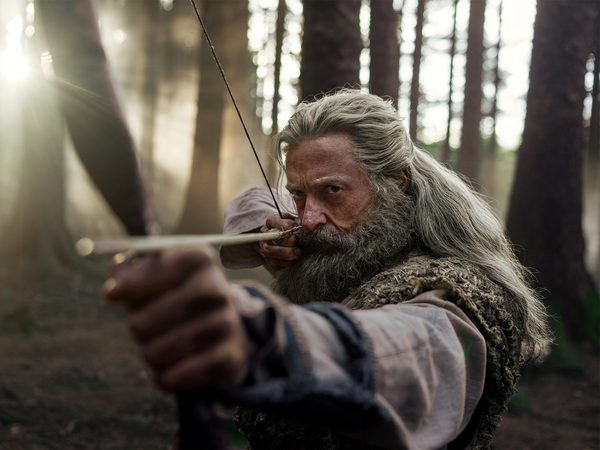
Hugh Jackman’s grizzled outlaw trades merry men for melancholy in Michael Sarnoski’s moody spin on England’s most recycled legend.
Robin Hood is one of many IPs that is routinely reimagined, revamped, and recycled. From the Disney animation movie to the much-loved scenery-chewing of Alan Rickman in 1991’s Prince of Thieves to two utterly forgettable 2010s versions, hearing that we’re getting yet another movie starring the communist thief isn’t likely to stir much anticipation. And yet, Michael Sarnoski’s The Death of Robin Hood, starring Hugh Jackman as the oldest and mardiest version of the title character we’ve ever seen, succeeds in differentiating itself from all other adaptations that have come before it. The director of Pig and A Quiet Place: Day One brings his signature blend of dourness and humanity to forge a story that is plagued by major pacing issues but still offers up a moody, brutal alternative to a familiar story. Aided with a stacked cast of Jackman, Jodie Comer, Bill Skarsgård, Murray Bartlett, and the terrific young performer Faith Delaney, The Death of Robin Hood may hit a lot of bumps along the way, but it’s still a path worth forging through.
Jackman’s Robin Hood is no valorous hero or wide-eyed do-gooder. He’s a tired, seemingly callous old man who is quick to kill anyone who obstructs his way. When his oldest friend Little John (Skarsgård) asks for his help in rescuing his family and land, which have both been taken under siege, it inadvertently sets Hood on a path of healing he would have never found on his own. When he is injured and awakes in a tranquil priory on an island off the coast of England, he is nursed back to health by the serene yet firm Sister Brigid (Comer). As Hood recovers, he interacts with people who have never had to resort to a life of violence, which helps him to finally step out of the legend that has surrounded him his entire life and into a person he can finally feel proud of.
It may sound like Sarnoski is making Robin Hood into a cookie-cutter tale of learning to be good, but it couldn’t be further from that. Sarnoski’s sensibilities are much more focused on dispelling the stories we tell ourselves to make us feel better about our lives, whether we’ve led them in virtue or sin. In tandem with Sarnoski’s feature debut, Pig, he finds a sweet spot in his characterisations of morally grey people reckoning with their choices. His take on this world is full of savage violence, sparse but effective uses of gore, and stylish fight scenes. With all that said, Sarnoski’s script is mired with stagnant pacing that can send the second half into a meandering current looking for a way out.
Sarnoski still manages to draw out terrific performances, particularly from the supporting cast. While Jackman hits every sore spot of such a troubled character, the standouts are easily Murray Bartlett, even hidden behind masks and bandages, and the young Faith Delaney whose innocent face is the reactionary canvas that amplifies the stakes of each scene she’s in. Comer, as always, is excellent, even if it does feel she is slightly underused.
Not a home-run but by no means a dud, there’s a lot more going on in The Death of Robin Hood than its IP and audience-friendly star.


0 Comments