
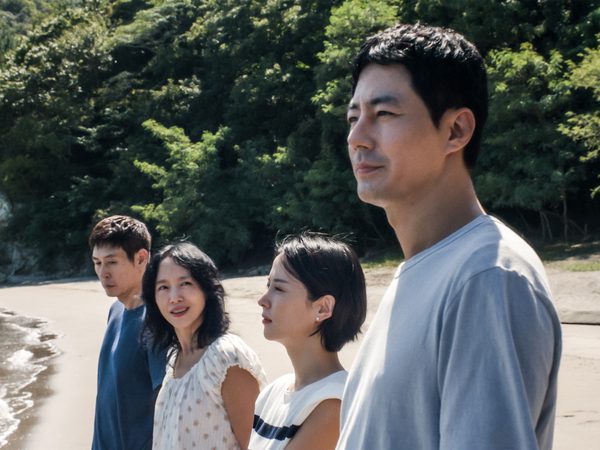
Two couples from contrasting social classes brush up against each other in Lee Chang-dong's relationship drama.
The tenth commandment prefaces Lee Chang-dong's Possible Love: Thou shalt not covet. Whether it's thy neighbour's house or thy neighbour's wife, the Good Book is clear about the price of envy, but it's hard to not believe the grass is greener when your own garden lies parched and withered. For Mi-ok (Jean Do-yeon) and her husband Ho-seok (Sul Kyung-gu) the past few years have been difficult; corporate restructuring resulted in a 40% workforce lay-off at Ho-Seok's welding job, and when the employees staged a sit-in strike it was violently broken by the state. Ho-seok hasn't been the same since, becoming reliant on alcohol to cope with untreated PTSD and pain, leaving Mi-ok to care for their 10-year-old son Cheok as well as hold down a blue collar job of her own.
Documentary filmmaker Ye-ji (Cho Yeo-jeong) seems to have an idyllic life by comparison. She's married to the handsome, athletic businessman Sang-wook (Zo In-sung) who comes from family money, granting her the security to pursue her passion via applying for art grants. The two women meet just as Ye-ji is embarking on a new film centring on the fired labourers from SP Heavy Industries, after Ho-seok causes a scene at a colleague's funeral. Ye-ji appears well-meaning enough, sincerely interested in Mi-ok's life and story, but it's apparent from their first exchange that the two come from different worlds. Mi-ok is quietly dazzled by the woman's designer wardrobe and good looking husband, who she giddily comments reminds her of Steve Jobs. Initially it seems that their differences might bring the women closer, though Sang-wook views his wife's new friendship cynically, remarking that she's merely "method acting" for the sake of her film.
Ye-ji resents that accusation, but there is a certain voyeurism to her actions that Lee subtly captures, whether it's in her habit of making Mi-ok retell stories once she has her camera ready or intrusively filming vulnerable moments. She's subtly pushy about interviewing the emotionally drained Ho-seok too, noting that his story will be great material for the documentary. Mi-ok thinks it will be good for her husband to open up, purely as a way to emotionally process what happened during the strike. Ho-seok is reluctant to go to the group therapy sessions his former colleagues attend, and certainly won't talk to his wife about what he's going through. When the dam finally breaks, it's heartbreaking but expertly executed.
Across his accomplished body of work Lee has always had a knack for needling at the specificities of domestic relationships; Possible Love does so with the same precision within the prescient landscape of corporate greed and rapid automated labour expansion. This is the same territory that Lee's countryman Park Chan-wook found so rich in 2025's No Other Choice, and certainly Possible Love hints at the same direct relationship that many South Korean men have between their job and their masculinity, albeit in a tonally divergent manner. Where Park's film used the rigid trappings of South Korean working culture as a rich playground for a cutthroat black comedy, Lee's drama is bittersweet, examining the tensions that arise in a marriage whenever the breadline is constantly in sight. It's clear that Mi-ok and Ho-seok, together since their teens, still care a great deal for each other, but economic stress has created fissures in their relationship. By contrast, Ye-ji and Sang-wook's relationship seems more opaque. Mi-ok remarks it's nice that they call each other by their names instead of the traditional honorific, as it feels like they're equals, but as we spend more time in their company that's not the prevailing picture.
Through tipsy confessions and wistful recollections Lee carefully unpacks the contrasting marriages, masterfully observant and tender in his approach. CCTV footage and documentary-style inserts create the sensation of being scrutinised that Mi-ok comes to find uneasy, subtly gesturing at the ethical quagmire within filmmaking regarding who has the right to tell others' stories. Meanwhile, smart conversation flows like so much soju, touching on the value of labour in a world rapidly pushing towards automation, and the inherent desire of parents for their children to have more than they did. Under the surface, desire is a knife edge, whether it's the blunt sense of ownership over everything that comes with generational privilege or the sharp ache of the working man for a sense of security. It's a remarkable feat that Lee contains so many narrative threads within Possible Love without ever losing command of them; rather they come together to create a drama that feels rich and lived-in, as thorny and multifaceted as any real-life marriage or friendship.


0 Comments