
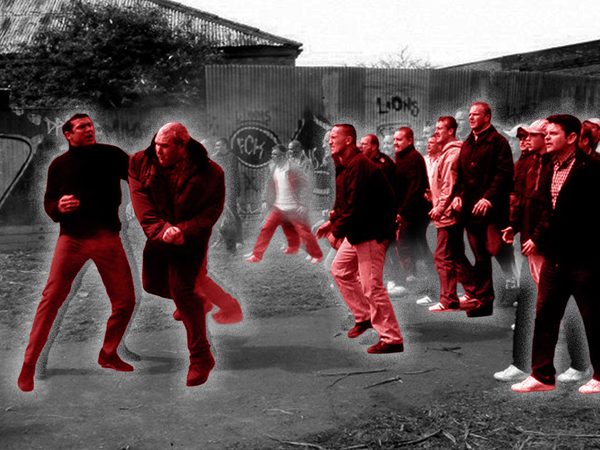
The far-right‘s increasingly hostile culture war against migrants echoes the fantasies of social collapse that weaponised British vigilante cinema in the 2000s.
On June 25th 2026, the richest man in the world shared the film Citizen Vigilante (Uwe Boll, 2026) with the 240 million followers of his X account. The film stars disgraced former Hollywood A-lister Armie Hammer as an ex-military officer who takes it upon himself to dispense violent justice to the gangs of roving migrants who terrorise an unnamed European city. Despite it receiving a near-universal panning in the press, Elon Musk clearly found something about the film compelling enough that he was willing to share it for free.
Indeed, the politics espoused by Citizen Vigilante – that a majority-white Europe needs to take a stand against mass immigration, violently if necessary – dovetails with Musk’s growing interest in ethnonationalist rhetoric. Here in the UK, Musk has repeatedly promoted the work of fringe nationalist figures including Tommy Robinson, offering them larger platforms and propelling them into a mainstream political discourse that increasingly leans towards extremist depictions of migrants.
The narrative of the British right increasingly hinges on a depiction of Britain as a failed state: a rainy, rotten cesspit of Turkish barbers and careening Deliveroo riders that has destroyed the sunlit uplands of Albion and replaced it with the so-called ‘Yookay’. Writing in the New Statesman, Nicholas Harris defines the Yookay as ‘garish images’ that ‘form a sort of dystopic comic strip, a racialised and frequently racist scrapbook of 21st-century British life’. The aesthetic groundwork for this racist fever dream was laid years before, and with different targets in mind, but only became ubiquitous in the political imagination with the onset of the migrant crisis, the ensuing explosion of nationalism, and the uncanny ability of AI to reproduce English council estates.
Yet it was once the working class themselves who were the target of the media’s ire: the white thug, the scally and the chav once occupied the bogeyman role now thrust upon the migrant. So ubiquitous was the terror around young men in tracksuit bottoms and hooded sweatshirts reverting to nihilistic, tribal violence, that even the British film industry began to take notice, producing a slate of class war thrillers that I dub the ‘ASBOwave’.
The introduction of the ASBO (Anti Social Behaviour Order) in 1998 had a profound effect on Britain’s public spaces, writing into civil law a curtain-twitching vigilantism against one's own neighbours that disproportionately targeted young, often minority ethnic or at-risk members of the public. A populist appeal to the propertied class, the ASBO reinforced stereotypes regarding who belonged where, ghettoising entire populations into disinvestment and ruin.
In Daniel Barber’s Harry Brown (2009), the Heygate Estate in South London during the waning years of the Blair administration fills the role of a societal microcosm. Like San Francisco during the long comedown of the 1970s was for Dirty Harry (Siegel, 1971), or Europe during the migrant crisis for Boll’s Citizen Vigilante, Harry Brown’s Heygate purports to stand in for the societal failures of its moment: a useful visual shorthand for state failure, moral rot and savage acts of violence. At the time of filming, the estate had already been largely emptied of its inhabitants as part of the Elephant and Castle regeneration scheme, the council handing the holdouts compulsory purchase notices on the behalf of developers. In the last years of its life, it became a popular destination for those in the film and television industries who sought a gritty backdrop for a crime film, and its legacy on film – through Top Boy, Attack the Block and Harry Brown – is now synonymous with urban crime.
Michael Caine, reprising the type of hardman role he established in films like Get Carter, plays a retired former marine whose life is upended by the criminal gangs that rule dominion over the council estate he lives on. The police, shackled by bureaucracy, are unable to detain the criminals themselves, forcing Harry to take up aggressive vigilantism after the death of his friend. In the film’s third act, a police attempt to restore order leads to a fully-fledged riot which they quickly lose control of.
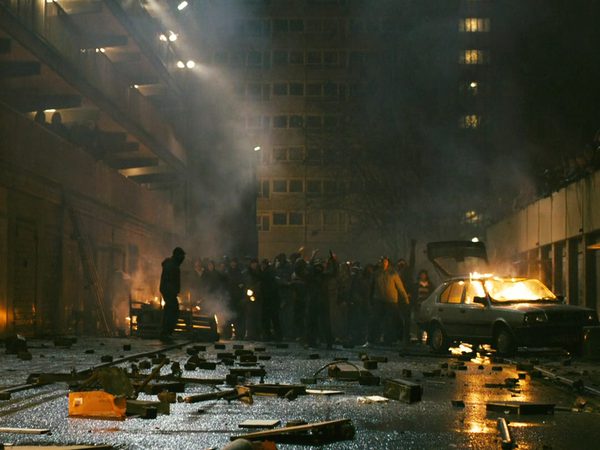
These sorts of images loomed large in the British establishment at the time; the prospect that the ‘social decay’ of the country would eventually lead us into all-out violence via the scourge of anti-social behaviour. Just two years later, the 2011 riots would realise the media’s worst fears, manifesting into reality the sort of apocalyptic imagery that Harry Brown had anticipated. In his response to the riots, the then-Prime Minister David Cameron blamed the ‘moral collapse’ of Britain’s ‘broken society’ which could only be mended by a rigorous programme of financial austerity.
Harry Brown was far from the only film of the time to indulge in class commentary at a time when the official stance of the government was that class divides had ceased to be of consequence to society. James Watkin’s Eden Lake (2008) ended up as a case study for Owen Jones in his book Chavs: The Demonisation of the Working Class, so virulent was its implied class hatred. The film depicted the gruesome murder of a middle class couple from London (played by Kelly Reilly and Michael Fassbender) after they run afoul of a group of ‘semi-feral’ working-class kids in a rural community. The gang are keen to capture their violent crimes on video, a reference to the contemporaneous social blight of ‘happy-slapping’ and the now long-held perception that technology warps the brains of the young.
The horrific violence of Eden Lake was not born simply from an urge to punch down at the lower classes. The Britain of the late 2000s was racked by a series of horrendous murders committed by gangs of young men against innocent bystanders. The murders of Garry Newlove, Rhys Jones, and Sophie Lancaster, among others, routinely appeared in the press as evidence of the nihilistic violence of working-class British youths. Terrible crimes became justification for ‘class disgust,’ as the Labour MP Stephen Pound put it: “I genuinely think that there are people out there in the middle classes … who physically fear the idea of this great, gold bling-dripping, lumpenproletariat who might one day kick their front door in and eat their au pair”.
Films like Eden Lake, in spite of their ostensible classification as genre fiction, tapped into the fears of Britain’s decline as represented by the political establishment, blurring the lines between fact and fiction and paving the way for a modern depiction of the UK as a dystopia crumbling along the fault lines of class and race.
Alongside films like Eden Lake and Harry Brown – which took their subject matter and flashes of ideology relatively seriously – the 2000s also saw a cottage industry of high-octane thrillers about Britain’s criminal element, centred around the work of directors like Guy Ritchie and Nick Love. Compared to the stern and serious social commentary of the ‘hoodie horror,’ films such as Love’s 2004 The Football Factory take a playful approach to the subject of masculine violence. When Danny Dyer’s Tommy Johnson is beaten half to death in a violent football scuffle, he is quick to reassure the audience that he considers the brutality absolutely worth it for the sense of community that the firm brings.
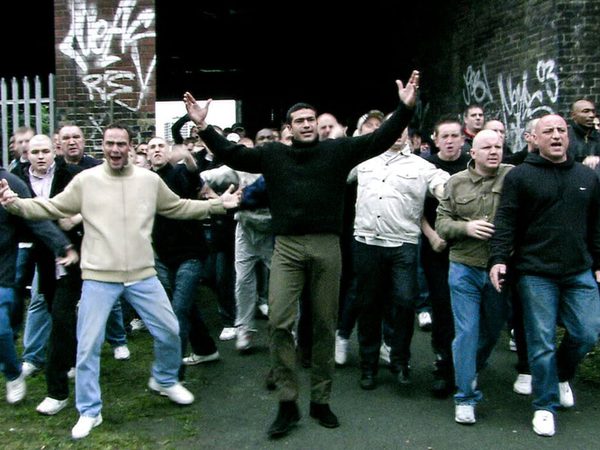
Here we see the flipside of this narrative of exclusion: if we are going to be treated as violent scum, then we shall wear it as a badge of pride. Of course, this is a tidy gloss on a much more complex cultural issue. Football hooliganism was never simply an innocent pastime unfairly vilified by a bourgeois media, but was in fact the pastime of upwardly mobile professionals and far-right thugs.
In fact, what the British crime film scholar Paul Elliott calls the ‘Gangster Light’ film, with its mixing of late 1990s New Lad sensibilities and ‘decontextualised and heavily edited images of England’s cultural and criminal past,’ offers an insight into the closed tribal mindset that modern nationalism often preys on: ‘England till I die,’ close-knit and ethnically well-policed. Perhaps as a result, the synopsis for The Football Factory ends up giving too much away: “The Football Factory is more than just a study of the English obsession with football violence, it’s about men looking for armies to join, wars to fight and places to belong. A forgotten culture of Anglo-Saxon males fed up with being told they’re not good enough and using their fists as a drug they describe as being more potent than sex and drugs put together.”
This is a false, nativist mythology – an attempt to reframe the English Disease as part of innate folk culture. This conception of the English working-class has become the dominant narrative pushed onto our screens by the far-right, a false consciousness that scapegoats migrants and those on benefits.
Love also turned out a remake of Alan Clarke’s The Firm, tuning down the more explicitly critical elements of the film in favour of a glossy ’80s pastiche of shell suits and Soft Cell. Clarke, for his part, chose to remain distant from his subject matter, turning down offers to meet with real football firms as he abhorred how they exploited his favourite sport. Instead, he used their violence as an avenue to explore the curdling of British masculinity, and the neglect of working-class institutions under Thatcher.
In addition, films such as Roland Joffe’s 1978 The Spongers and David Edgar’s Destiny, from the same year, also explored conditions of deprivation, resentment and violence. Crucially, these films approached their subjects with a critical eye, refusing to take stereotypes of race and class for granted. This could be attributed to the relatively diverse (for the 1970s) team of writers and directors commissioned for the series; artists who often brought their own experiences of growing up in Britain’s class-riven society to their work. By the 2000s, decades of artistic disenfranchisement – the closure of the working men's club and the local theatre – had excluded all but the most determined working-class artists. As a result, their narratives were boiled down to either ‘aspirational’ stories of individual success, or condemned as examples of a failing society.
Within artistic circles, there is a constant, churning debate about the ability of art to adequately depict and dissect our digital hellscape. Images have become untrustworthy, online narratives bleed out into our world in the form of shocking acts of vigilantism and rioting. What many of the crime films that Britain produced in the early 21st century seem to lack is a sense of scepticism about the country they claim to depict – a reluctance to look behind the topline. This trickles down into our received attitudes about the state of the country, unravelling the fabric of truth and establishing false and harmful stereotypes. It’s these illusions that allow the likes of Robinson and Musk to turn communities against each other.
Through the ASBOwave’s combination of ironic masculinity and cruel violence, the UK film industry found itself towing the line of the dominant ideology: one that scapegoats those most abjected by society – the poor, the refugee – when it has in times past shown that it is capable of challenging the official narrative. This is the industry that produced Franco Rosso’s Babylon, Raine Allen-Miller’s Rye Lane, the works of Steve McQueen, and innumerable other films that tell a different story of the country. A country that the writer Paul Gilroy identified as convivial and multi-ethnic, broadly at ease with difference, yet occasionally stoked to post-imperial rage by bad actors. Despite its past failures, British film still has the potential to reckon with modern life in Britain, to challenge doomsaying and division, if it can only rise to the challenge.


0 Comments