
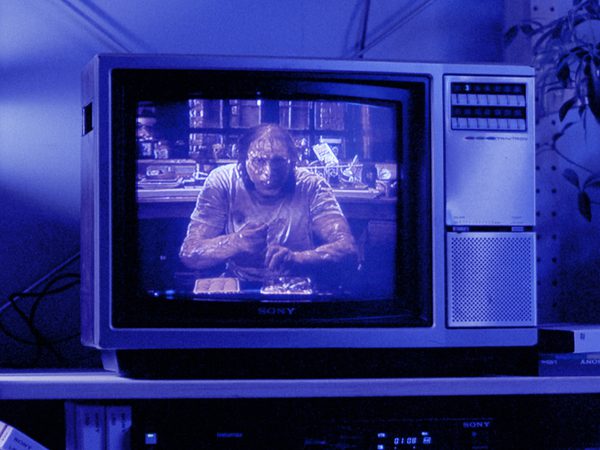
Self-optimisation technologies only expose how profoundly our sense of self is bound to the body – the Canadian auteur’s materialist philosophy serves as a pertinent reminder.
David Cronenberg’s most commercially successful film is gleefully gross: fingernails ripped from decaying flesh; digestive juices oozing onto a doughnut; a head splitting open like rotten fruit. Four decades on, The Fly is still regarded as one of cinema’s most potent horrors, retaining a legacy that has achieved an ironic sort of permanence given the Canadian director’s lifelong fixation on the transience of the human body. Where Kurt Neumann's 1958 original tapped into the decade’s Atomic Age fear of science slipping beyond our control, Cronenberg's version offered a more specific reckoning – the body's inevitable breakdown. Released in 1986 amid the AIDS crisis, its depiction of bodily deterioration and estrangement was widely read as an allegory for the fear, stigma and loss that defined the epidemic. Now, in a culture stifled by the self-optimisation economy, the film appears newly resonant, the body horror exposing the fantasy that our corporeal form should be perfected or transcended. Our bodies are still alien to us, fleshy and unruly, but we are surrounded by an oversaturation of technologies that deepen this alienation under the guise of improvement: AI, biohacking, wearable tech and even ‘looksmaxxing’.
The film opens with the scientist Seth Brundle (Jeff Goldblum) eagerly giving journalist Veronica Quaife (Geena Davis) exclusive access to his laboratory to witness the teleportation machine he invented in action. Inanimate objects pass through the device without issue, as he demonstrates with one of her stockings, but living tissue does not, shown when an unsuspecting baboon is turned entirely inside out. As Brundle observes of this failure, the machine cannot “deal with the flesh” because he has not input the data sufficiently enough. A breakthrough comes, notably, after he and Veronica have sex, providing the necessary insight to reprogramme the computer, which finally results in a (more fortunate) baboon being teleported unscathed.
Brundle abandons scientific caution after seeing Veronica leave one night to meet her editor and ex-boyfriend. Consumed by jealousy and desperate to prove himself, he gets drunk and teleports. Brundle emerges with greater strength, stamina and libido, which is interpreted by him as a technological process of purification that stripped away human weakness to reveal his full potential. The only benefit given for his invention, which Brundle insists will “change the world,” is that it will spare him the motion sickness he's suffered since childhood. This small and mundane discomfort, a quiet reminder of how tethered we are to our corporeality, is reason enough to disregard the body as just a nuisance to overcome.
Brundle's embrace of optimisation soon gives way to psychological and physical collapse because a housefly, unnoticed, had trapped itself in the telepod with him. Faced with two living organisms instead of one, the computer infers that the appropriate course of action is to genetically splice these incongruent beings together. Gradually, nails and teeth loosen from tissue, coarse hairs poke through delicate skin and the body tears apart to reveal a man-insect hybrid known as “Brundlefly”. Cronenberg lingers on every stage of this brutal metamorphosis, emphasising the body's sheer ungovernability against Brundle’s frantic will to stay human.
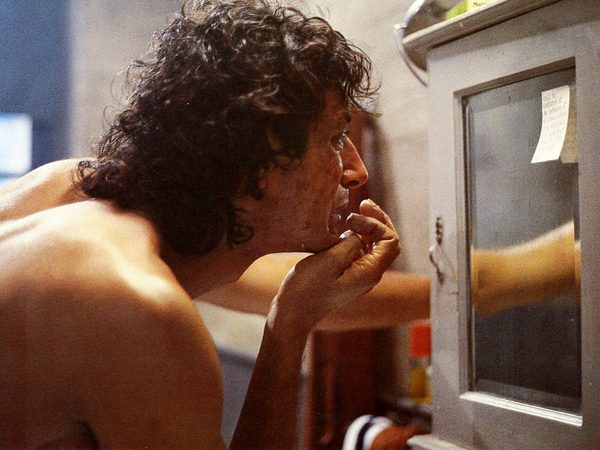
Body horror, at its best, reacquaints us with the flesh, asking us to accept the strange and often disturbing experiences of what that entails. Veronica's nightmare of giving birth to a writhing maggot-baby – arguably the film's most unforgettable image – locates that same fear of threatened bodily autonomy in unmistakably gendered terms. Brundle fears the body he no longer recognises, but Veronica fears a body capable of producing new life beyond her control. It is this viscerality, rendered through the film’s Oscar-winning practical effects, that captures the fraught relationship with our bodies so acutely.
Of course, simply being acquainted with the flesh does not liberate us from a system that alienates us from it, and then profits from that alienation. Embodiment is repackaged by the wellness industry as a means for self-optimisation, whether through meditation apps or corporate health retreats, ensuring we function more efficiently under capitalism rather than question its exploitative logic. Likewise, entertainment turns shock, disgust and gore into content that gratifies our need for sensation while dulling our response to suffering. With the recent popularity of body horrors, spectacles like The Substance – often praised for encapsulating the violence that women inflict upon their own bodies to stay desirable and consumable – should also urge us towards something more transformative than momentary catharsis. Cronenberg explores a similar concern in the post-pain world of Crimes of the Future, where surgery is performed on stage for an audience who, starved of sensation, use it as a substitute for emotional and sexual connection. For him, the blight is when our capacity to feel becomes so disembodied that feeling itself can only be simulated.
The Fly by no means offers political salvation, but, like much of Cronenberg’s filmography, it avoids outright nihilism by insisting that the body’s fragility is the very condition that makes life meaningful. This is pertinent as we now exist at the mercy of longevity-obsessed venture capitalists who view death as yet another technical challenge. Jeff Bezos, Sam Altman and Peter Thiel have all invested millions into anti-ageing research. While Brundle destroys himself in his attempt to transcend the limitations of the flesh, these men will, until that same fate arrives, continue to amass their grotesque fortunes by making ever-greater optimisation and productivity terms for our survival.
A year after Charli XCX declared it to be “CRONENBERG SUMMER” during her Coachella performance, the director now has a spoken-word feature on her new album. The track, titled ‘No One Lasts Forever,’ which includes a recording from an hour-long conversation between the two, explores impermanence in relation to fame, art and mortality: “Oblivion is freedom,” he reassures her about legacy, as “They are dead, they are gone, no one lasts forever,” echoes until the song’s conclusion. Ultimately, Charli – whose hedonistic persona can be understood as both a symptom of and a response to this generation’s unrelenting self-performance – shares Cronenberg’s preoccupation with how to live meaningfully within such dehumanising limits.
There is a symmetry, then, to Cronenberg featuring on an album closer preoccupied with what survives us. The Fly provides a paradoxical kind of answer, having achieved timelessness by so viscerally denying the fantasy of transcendence. Brundle believed a computer freed him from these limitations, it instead proved that there is no self waiting beyond the flesh. As Cronenberg shared in 1999: “The further from your own body you get, the less real everything is… the less you connect with it. But if you embrace the reality of the human body, you are embracing your own mortality.” The Fly remains so affecting because it compels us to face this truth.


0 Comments