
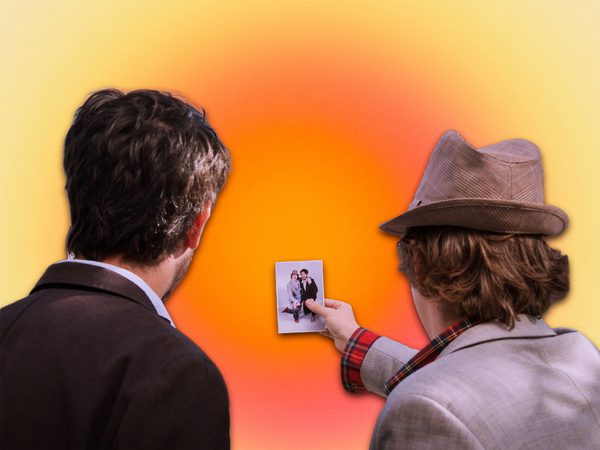
Beyond the ever-growing title, the theatrical outing for cult comedy duo Nirvanna The Band is a metatextual triumph – we explore the rich pop culture references, cinephilia and absurdity that led to this inevitably layered movie outing.
Director Matt Johnson breaks the fourth wall in Nirvanna the Band the Show the Movie to congratulate the audiences watching the film in theatres: “This is going to be a copyright nightmare!” It’s a thought that has crossed the mind of viewers of the comedy since 2007 but it is a rare moment of metacinema to have the film’s director, already playing a character version of himself, raise the issue mid-scene. Although rare in cinema, the tongue-in-cheek self-awareness of Nirvanna the Band has been present from its beginnings.
Originally a web series running until 2009, the show (formerly spelled Nirvana the Band the Show), centred on fictional versions of its creators – Matt Johnson and musician Jay McCarrol – as the duo come up with a series of cartoonish plans to try to secure a booking at the Toronto venue, The Rivoli. Long-time real life best friends, the web series depicts the pair meeting aged nine and instantly forming a band through a series of flashbacks parodying Lost and The Wonder Years, instantly setting the tone of the blurred lines between the real and the imagined.
The television series premiered in 2017 on Canadian channel Viceland, and saw the addition of an extra N to become Nirvanna the Band the Show. The title change itself is an indicator of the tightrope walk between the reality of the show’s plagiaristic pastiche and the imagined world of the clueless band’s pop culture-addled minds. An early punchline indicating just how unaware the in-world characters are around any copyright problems of their chosen nomenclature sees the comedic realisation that “there’s already a band called The Band”.
The real-life Johnson and team are, of course, incredibly savvy in creating this world. Working closely with lawyer Chris Perez to stay on the correct side of fair use and parody law, as well as navigating the signature guerilla on-location shooting style, these efforts are integral to the comedy’s unique humour and an on-screen execution that is part-magic trick and part-“how did they do this?”.
The core DNA of the show is traceable to a number of turn-of-the-century comedic relatives and combines elements of many of the popular movements in comedy at that time: the mockumentary boom led by fellow Canadians Trailer Park Boys, Ricky Gervais’ The Office and the original Larry David: Curb Your Enthusiasm; the hidden camera aesthetic of Trigger Happy TV, the work of Sacha Baron Cohen, and the fellow Spike Jonze-produced Jackass; heavily pop culture-influenced shows including The Simpsons, Spaced, South Park, Family Guy and Community; and of course, hapless musical duos looking for success including Tenacious D, Flight of the Conchords and Garfunkel and Oates. Yet unlike the latter duos, or indeed song-fuelled contemporary shows like The Mighty Boosh, the absurdity of Nirvanna The Band is heightened by a lack of songs. Although McCarrol has the musicality of a Bret McKenzie or Kyle Gass, it is a part of the fabric of the show that there is no need to prove that the band are actually talented in spite of their lack of popularity. It’s clear throughout that the intended goal of getting a show is somewhat meaningless in that there isn’t really an act to perform.
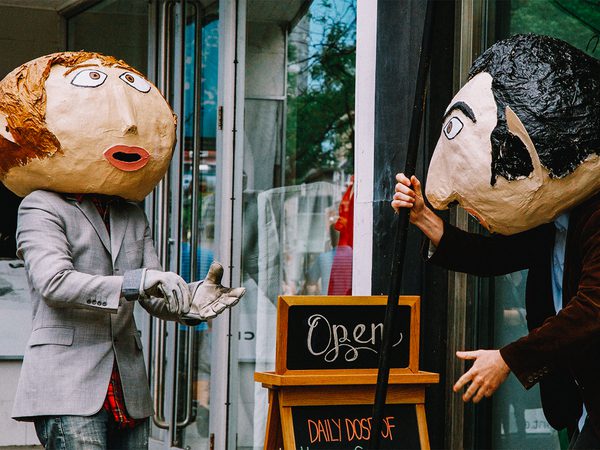
Repetition is a part of this theatre of the absurd. As “Matt and Jay try to get a show at The Rivoli…” appears at the start of almost every episode, the series is defined by increasingly complicated schemes to try to secure a gig; displaying an accidentally explicit banner of the band opposite the venue, various heists and break-ins, and even kidnapping a sick child in the hope of hijacking their Make-A-Wish request. No lessons are learned from their schemes or mistakes, just as ultimately no progress is made. This cycle of continual, hopeless stasis in spite of continuous dreaming, scheming and loitering sees ‘Waiting for Godot’ turned into Waiting for a Show.
Unlike other shows where a mooted or desired movie never came to fruition – or, like Community, are long-running gags and sources of speculation – there has always been a dogged sense of forward motion of the real-life Nirvanna The Band, even amidst periods of hiatus. This can be seen in the growing ambitions of the evolution of the work, which always seemed to be looking ahead, running in parallel with the ambitions of its creators. Taking the opening credits as an example, those of the web series predominantly referenced television shows including Frasier and The Wire. Moving to television, the reference points moved to cinematic touchpoints including Home Alone, My Dinner with Andre and Dog Day Afternoon.
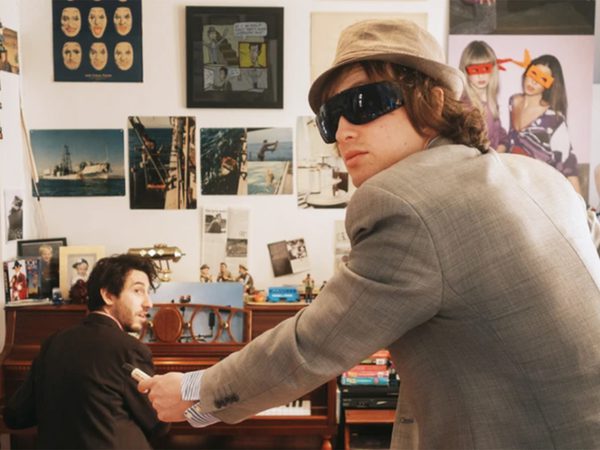
The duo’s world grows too. The original apartment and its recurring gag of a copy of 1993’s Dragon: The Bruce Lee Story becomes a house wallpapered with Criterion Collection posters and decorated with a sprawling VHS collection. The setting becomes catnip for cinephiles; arthouse posters for Antonioni, Fassbinder and Bunuel films blend with mainstream hits Jurassic Park, Heathers and The Naked Gun and eagle-eyed sightings of curios including Don Cherry’s Rock Em Sock Em 5. The increasing visual references within the home that the characters inhabit matches that of the complex world of the show, which is influenced by their escapism into films, TV and video games.
The ascension of the show in both scope and ambition ran alongside Johnson’s own move into feature film direction with The Dirties (2013) and Operation Avalanche (2016), the latter of which premiered at Sundance and inspired one of the key Nirvanna episodes, ‘The Big Time’, which sees the band’s attempt to make it big by making a movie. As with other semi-autobiographical elements of the show, the inept film that the duo make is an alternate-reality film, also titled Operation Avalanche, and gets snuck into the festival by Matt. The multiverse feel is rounded off by a quarrel being mediated by Sundance regular and fellow Jay-partner Kevin Smith, playing a version of himself.
It might feel like a stretch to suggest that this is proof of any grand plan to ultimately reach cinemas. However, foreshadowing has been a key element of the show. A seemingly throwaway moment in which Jay gets distracted by borrowing VHS tapes from a library in ‘The Banner’ (S1,E1), including Jurassic Park, Home Alone and The Negotiator, is notable in retrospect, as all become the basis of future episodes, including the season’s bank robbery finale.
Likewise, in the first episode of the TV series, there is a familiar sound cue from Back to the Future that is ultimately resolved in The Movie: a time-travel plot heavily inspired by Back to the Future with a healthy side-dose of The Butterfly Effect. Not only is the film a natural conclusion of the growing scope and depth of ambition from web, to television, to feature film, but it is also the logical endpoint of its continuing absurdity. If the series transformed Waiting for Godot into a sitcom premise, the expansion into a science-fiction feature film sees the metaphorical loop of the show converted into a literal one.
Opening in 2008, The Movie uses footage from the original web series to re-establish and reiterate the central plot driver of getting a show at The Rivoli. A ‘17 Years Later’ intertitle brings us to 2025, as Matt runs into the living room with a new plan, ‘The Seventh Inning Skydive’, a typically hairbrained scheme to skydive from the CN Tower into the Skydome to grab The Rivoli's attention. The ensuing opening credits are again foundational in foreshadowing the direction of travel, as a full rendition of Ben Folds Five’s ‘Army’ plays. The song is usually heard in short at the very end of episodes and thus, here, signals a circular beginning at the end.
After the inevitable skydive failure, a new ‘Time Machine Plan’ is hatched. The initial idea is to pretend to be from the future for the persuasion of a live booking. However, the spillage of Orbitz – a short-lived Canadian soft drink that was discontinued in 1999 – becomes the key ingredient to creating true time travel. The duo are reluctantly returned to 2008, creating an alternate timeline in which Jay becomes famous with a version of ‘Never Come Down’, his real-life 2014 jingle turned hit with Brave Shores, echoing the prior meta-mirroring of Johnson’s Operation Avalanche.
In returning to the era of its creation, The Movie is one of the most effective in a run of recent comedy revivals reckoning with a not-always-PC past. The horror of returning to 2008 sees the duo of 2025 now thrust into a world of Bill Cosby on magazine covers and The Black Eyed Peas using the r-word as a chorus to a chart hit. It is not until escaping into a screening of The Hangover that the widespread laughter of the audience to the repeated use of the homophobic f-slur that the time travel is recognised. Johnson himself used the same slur in the opening scene of the original web series and, similar to the introduction of an HR department into the recent Scrubs revival that challenges its prior comedy, it is the acknowledgement that attitudes have widely moved on.
Artistically, The Movie also takes a leap into new territory by effectively editing together footage from the time and newly shot footage to have the duo of the past co-exist with the time travellers of 2025. It is an additional magic trick that transforms the previously discrete absurdist cycles of individual episodes into a larger cycle, adjoining the band's past and present. True to form, this narrative device immediately leads to Johnson asking the question, “we are trapped in 2008 – how can we use this to get a show at The Rivoli?”, indicating that as an audience, we too are trapped within this increasingly complicated, futile cycle.
The existential responsibility to create one’s own meaning in an inherently absurd world is ultimately achieved through perpetual hope, influenced by forays into nostalgia, escapism and the joy of shared worlds. In a sense, the repeated joy found in doing so is in itself a form of enlightenment, or indeed, Nirvanna. Where the characters Matt and Jay may fail in their lofty schemes to get the show, their real-life counterparts continue to pull it off. Reminding an audience directly that the film is a fictional work, and that copyright issues may hinder theatrical release also acts as a reminder of just how special theatrical engagement truly is. It encourages us to reflect on the importance of our own escapist forays and the friendships that often develop alongside them.


0 Comments