
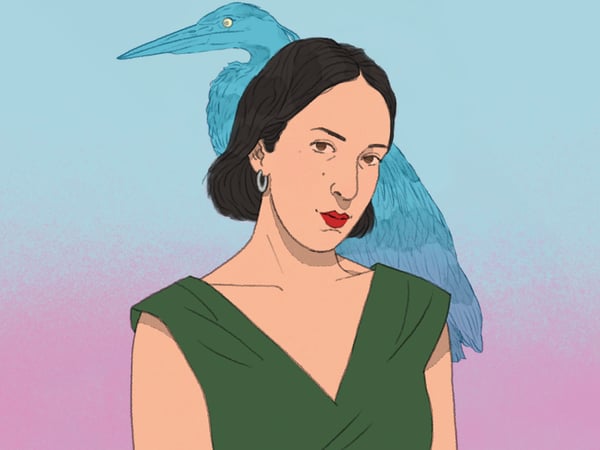
The writer/director of Blue Heron on how the nostalgic power of cinema can create poetic chronicles of the past.
Blue Heron is only the first feature film from Sophy Romvari, but through a formally inventive examination of familial trauma, childhood memory and understanding of a life in retrospect from the outside looking in, the Canadian filmmaker has crafted an incredibly sensitive and resonant work. The film adopts the perspective of a family’s youngest daughter observing her eldest brother’s troubling behavioural issues and the broader effects that has on the family, before shifting into a self-reflexive study of art as a means of processing grief.
LWLies: Where did the film begin for you? Was there a specific memory, image or sound?
Romvari: It was more the structure. I started with trying to depict a point of view that I felt was very specific, which is a sibling’s point of view in a very ruptured family dynamic. I’ve seen other films that depicted this dynamic but usually from the perspective of Jeremy, or of the parents, but to my memory, I’ve never seen it from a sibling’s point of view. That was the screenwriting challenge, how to make that make sense, and because of that character point of view being so distinct, it led into this bifurcated structure of the first half and the second half being from a child’s point of view and then the adult’s. Sticking with that, it forced me to make creative decisions that I maybe wouldn’t have otherwise.
There’s a fascinating relationship between routine and rupture where domestic repetition is undercut by the situation’s persistent unease that becomes normalised. Was duration itself something you were thinking about structurally?
Thank you for pointing that out. I was thinking about that a lot while writing – the repetition of the family dynamic to the point where it should feel normalised and repeating the same beat again and again, where we’re in a mundane family moment and then it’s ruptured by Jeremy in some kind of way. The attention gets taken from Sasha over to Jeremy in a way that’s repetitive purposefully so that it feels normalised for her, but also for the audience to feel that this is just the daily mechanism that this family goes through, and trying to make the audience feel like they’re living in that until it’s broken by the structure of the film. Just sitting with the characters in boredom, not in a forceful, slow cinema way, but in the reality of what it is to be a kid. So much of being a kid is being bored and then something happens suddenly, especially when you’re not being distracted by screens. I wanted there to be a sense of boredom as well as a sense of chaos and have those two things intermingling.
You weave certain cinematic references into the film – Jeanne Dielman, 23, quai du Commerce, 1080 Bruxelles, and you’ve also mentioned Céline and Julie Go Boating as an inspiration. Could you speak a bit about what you were drawing from them formally or emotionally?
Jacques Rivette deals with time travel in Céline and Julie just through the editing, but he also has an object that they use, this hard candy that helps them transport through time... I also wanted there to be an object, so the keychain became a narrative device, a symbol of the fact that time had passed and that Sasha held onto this object. It really was watching that film while writing the script that unlocked that. Having these minor inspirations from movies that are very different can be very helpful in the process of making films and writing scripts. A lot of people ask me what my advice is on writing scripts and I’m like, watch more movies!
The Jeanne Dielman shot initially started out as more of a classic homage. The more that we planned the film, and like you mention, the durational elements, that purposefully became one of the longer shots, trying to have audiences sit with the discomfort that Jeanne Dielman does so well. It’s one of those films that I watched and realised how much time is a part of watching a film and how [Chantal Akerman] wants you to feel the time passing. I liked the idea of rupturing that image by putting a child in the frame of a shot that is so iconic as a way to play with the homage. The Tree of Life was a big inspiration as well. [Terrence Malick] writes very visually, but there’s something where you can tell that only he could have directed these images from this script. Most of the inspirations I’ve taken were from movies that I love that I found a subtle way to integrate. I tried to infuse my love of movies into this movie.
The other inspiration came from my dad’s home videos – they were very artistically put-together. When you watch home videos, they’re clipped together in that way where you see something happen, and then all of a sudden on the tape there’s a whole other unliked event. It has this disjointed, elliptical nature. We tried to apply that same aesthetic and approach to the cinematography. I wasn’t really worried about how one scene led to the next because I think those scenes can all be moved in different places that still work.
I was really drawn to Jeremy’s maps, how he attempts to find coherence by drawing them, kind of like how the film works as an act of care to reach towards a sense of recovery while assessing the limitations of that journey altogether…
When we think about difficult things like grief and mental illness, or even a lack of understanding around those things, it’s about accepting difficult realities. In most of my work, that’s been the motivation. Making the work forces me to confront those realities, and then when you share the work, it becomes even more real and then you have to give it to other people to have their own experiences with, and it no longer is your own experience. If there’s any catharsis, it’s that. It’s not about closure, it’s more ‘this is as far as I can interpret this situation which is difficult, but it’s not something that I can solve’.
I wanted to ask about the scene with the social workers – there’s a switch to a very natural, unpredictable rhythm.
We cast real social workers based on their professional opinions. It was important for me that the dialogue was coming from an expert opinion and not just something that I wrote. These people are social workers because they believe in the practice, but also understand that there’s a lot of limitations to it. We did a lot of research and interviews to predict what the scene would look like because I knew in the end they would say that things had changed but ultimately not that much. The way we shot that was by allowing them to get to that place organically. We shot like, three hours of unscripted conversation and we covered it with three cameras at a time and just let the conversation play out. It’s one of the ways I like to integrate a sense of realism in how people play themselves. This is actually one of the ways I’m able to get people to not act. I’m always trying to find ways to limit the amount of performance, because it allows for that naturalism.


0 Comments