
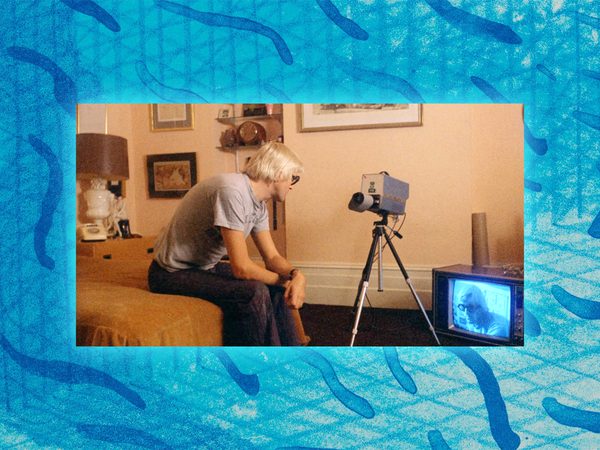
How Jack Hazan’s 1973 intimate portrait of the late David Hockney at work, play, and through emotional turmoil, strangely anticipated how we consume images of celebrities today.
It seems oddly fitting that David Hockney’s death should coincide with a heatwave. After all, nobody can evoke the languorous feeling of summer quite like the Yorkshire-born painter, who passed away earlier this month. This unique sensibility is particularly apparent in Hockney’s iconic LA paintings, which he produced at an enviable rate throughout the 1960s. To stand in front of one of these huge, cerulean canvases is to be transported to another world: one of swimming pools and sliding doors; blue skies and bare bottoms; tan lines and tight-fitting shirts. You can almost smell the chlorine, and feel the hot tiles under your feet.
It is this same sun-bleached fantasy which the director Jack Hazan attempts to recreate at several moments throughout A Bigger Splash, a documentary which borrows its name from one of Hockney’s most famous paintings. The film follows the young painter over the course of three years – from 1971 to 1973 – depicting his struggle to find inspiration after a devastating separation from his model and muse, Peter Schlesinger. Revisiting the film today, Hazan’s knack for composing beautiful cinematic images is still abundantly clear. What is even more striking is the ways in which the director interrogates the cult of Hockney’s celebrity, foregrounding the tensions that exist between the artist’s personality and his public image and, in the process, producing one of the earliest permutations of modern reality TV, decades before the rise of personality-driven media built around the commodification of everyday life.
On the one hand, Hazan’s gaze is unflinching: exploiting a range of verité techniques in order to offer audiences a glimpse into the quotidian reality of celebrity life. The sequences which he records within Hockney’s private studio, for instance, are mesmerising in their patient observation of the artist’s process. Hazan is also granted unfettered access to the artist’s private home – at one point even joining Hockney in the shower. Yet the film’s most daring scene features footage of Schlesinger having sex with another man. It’s a sequence that is particularly bold considering that homosexuality in the UK had only been decriminalised only five years earlier. However, it also seems to have been a step too far for Hockney, who flew into a rage at an early screening, and reportedly threatened to pay £20,000 for control of the negatives.
Whilst the raw intimacy of A Bigger Splash may have scandalised even Hockney himself, to describe it as an unmediated version of reality feels somewhat reductive. It is a film that is far stranger, and more subversive than that. Like his American counterpart, Andy Warhol, Hockney often treated his public image as an extension of his art; his bow-ties and bleach blonde hair serving as a costume to hide his own sense of being an outsider. Hazan’s film purports to offer an unvarnished ‘portrait of the artist,’ but it challenges this cool exterior. Instead – much like contemporary shows such as Keeping Up With the Kardashians or Selling Sunset – Hazan seems keen to indulge the artist’s self-mythology, treating him like a character who is not quite real.
It is clear that many of the scenes follow a roughly pre-agreed script (commonly known in the reality TV world as ‘soft scripting’) with individuals playing fictional versions of themselves. Even when we see Hockney reflecting on heartbreak with one of his girlfriends, both characters seem to be flirting with the camera, censoring themselves accordingly. The result of such self-consciously staged conversation is something far more unstable than reality. Indeed, it is almost as if we, the viewers, have been immersed in one of Hockney’s paintings, where everyone seems at once familiar and completely unreal.
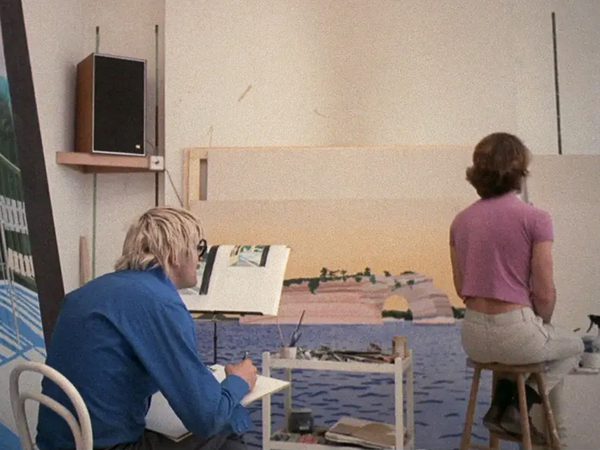
This strange dance of fact and fantasy is only intensified by a range of other formal tricks. At several points throughout the film, the artist’s paintings are featured within the director’s frame, as if part of the mise-en-scène. But these canvases take on a different role when characters stand in front of them, modelling the porous boundary between reality and its representations. There is a particularly moving moment when designer Ossie Clark poses – with his pet cat – in front of his portrait with his wife, Celia Birtwell, from whom he was already separated by the time A Bigger Splash was first released. Like Hockney, he seems to be caught in a past which can only be re-lived through painting.
Shots of Hockney asleep in bed glide and shift seamlessly into a series of lyrical dream sequences, which feature young men like those he would observe by LA’s shimmering poolsides. In one particularly beautiful scene which recalls the homoerotic fantasia of Derek Jarman’s films, we see a completely nude Schlesinger doing laps in the pool. Having surfaced from underwater, he is joined by an entourage of other naked young men who dive in together. It is an undeniably sexy scene: combining the visual language of Hockney’s art with the kind of smutty imagery of Physique Pictorial, the artist’s favourite erotic magazine. The hazy atmosphere is only intensified by Peter Gower’s powerful semi-operatic score which trills throughout.
Taken together, these sequences lend the film an undeniable formal strangeness. It is this quality which led several American reviewers to pan A Bigger Splash and label it as ‘boring’, ‘stuffy’, and ‘overlong’. Nevertheless, it is that same subversiveness which makes Hazan’s film such an apt tribute to Hockney. After all, the artist could never settle for reality himself. The imaginative and erotic possibilities of painting were always far too tempting – offering an escape-route from the grey and repressive landscape of post-war Britain into a new world filled with boys, and pools, and brilliant sunshine.
It is this same fantasy-land which appears in ‘Portrait of an Artist (Pool with Two Figures)’, a canvas we see Hockney completing over the course of A Bigger Splash. The resplendent picture depicts a young man in a pink jacket looking down at a male swimmer, whose body shimmers beneath the surface of the water. Viewed again today, it embodies the contradictions that animate Hockney’s early work: presence and absence, beauty and decay, desire and loneliness. It also helps to summarise the feeling one has watching A Bigger Splash. Like the man in the pink jacket, Hazan invites his audience to observe a world that might as well be underwater: at once dazzling, sexy, and completely unreal. His vision is at once strange and strangely alluring. As a heatwave sweeps Europe, you would be forgiven for wanting to dive in. After all, it looks much cooler in there.


0 Comments