
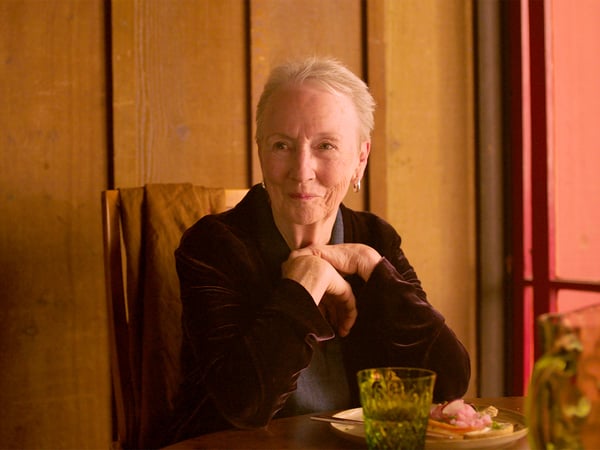
Kathleen Chalfant stars in this deeply tender drama about an elderly woman adjusting to life in a care home as her memory begins to fade.
For a medium so indebted to memory in the way it evokes, retains and edits images together, cinema often underestimates the importance of forgetting. Identity is predicated on remembering in the same way that narratives are based on conflict and resolution, but this is not the case for a remarkable feature debut called Familiar Touch. Sarah Friedland’s prior work includes choreography and filmmaking, and a synthesis of both informs her Movement Exercises trilogy of short films as a primer for a feature debut of radical tenderness. Familiar Touch introduces us to Ruth (Kathleen Chalfant) – a gleeful woman in her eighties with a gastronomic fervour and the diminishing ability to recognise her son (H Jon Benjamin). “It’s Steve,” he helps her out when she cannot recall his name.
While Ruth prepares a tray of the most exquisite-looking salmon and cream-cheese toast, her plating and tableware a clue indicating a long life of exactitude and passion for cooking, something feels off. She shoots Steve a flirtatious glance, he forces a smile – a close-up of her hand on his thigh arrives like a jolt in a sequence of long takes and the spell breaks. A split like this cannot be undone, but this is why Steve is taking his mother to Bella Vista, a care home she has apparently already chosen for herself. Early on, the film’s domestic set-up is exchanged for an institutional one, but we accompany Ruth throughout, in her confusion and moments of peaceful surrender.
Following months of caregiving work and filmmaking workshops with the Villa Gardens continuing care retirement community in Pasadena, Familiar Touch is a product of ethical collaboration of the highest degree. The film focuses on Ruth so wholly, yet without surrendering to the kind of subjective techniques used to establish identification and evoke empathy. Cinematographer Gabe C Elder translates the golden rule of care work – communication at eye level – to the camerawork, keeping the long, static takes at a respectful distance in the definition of what can be called a caring gaze. Yet the camera doesn’t have to “hold” Ruth, whose resistance borders on denial, refusing to identify with her dementia diagnosis. “I would like you to be unconcerned,” she barks at Steve in an act of defiant self-assertion.
Chalfant is a stellar lead, to say the least. A prolific and successful actor across stage, film and television productions, she can embody a hundred Ruths in a fluid succession of micro-gestures and make getting to know her a rare delight. Her disarming looks emphasise an autarchic side that shows up when challenged, often in a beautifully calibrated triangle with carer Vanessa (Carolyn Michelle) and doctor Brian (Andy McQueen), the latter of whom receives a recital of her personalised borscht recipe. Cooking and the recipes appearing in the film give a material dimension to Ruth’s past as much as the scenes of misdirected erotic energy, to paint a portrait of an ageing woman who’s not defined by the social roles of mother or wife. Memory may be slipping away from Ruth, but her enchanting, raw presence will stay with you for ever.


0 Comments