
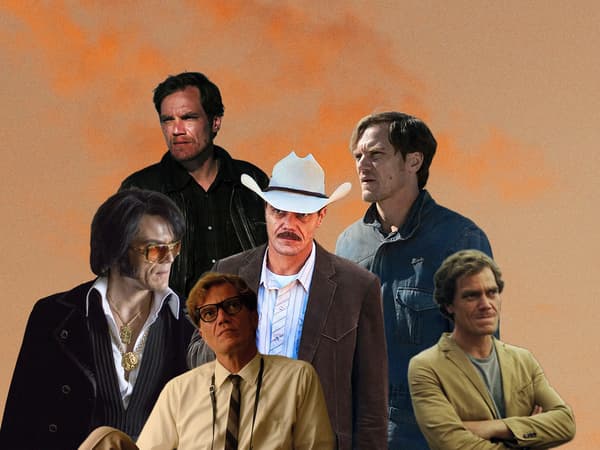
In 2016 Michael Shannon appeared in 10 feature films – together they prove why he's one of the most compelling actors around.
People rarely write about Michael Shannon without using the word ‘intense’ or a similar descriptor. Over 6ft 3, with wide-set eyes and a heavy brow, he can be an intimidating presence – at no time was this more apparent than in 2016, when he starred in no less than 10 feature films. Taken together, they paint a kaleidoscopic portrait of a captivating actor with imposing range, who’s able to elevate even the most unremarkable productions. While the moments on screen when he explodes are electric, it’s not so much the explosions themselves as the threat of them that make him such a powerful performer.
Of his 2016 movies, this is especially apparent in Wolves. He plays Lee, the gambling addicted father of high school basketball player Anthony (Taylor John Smith). Lee isn’t an abusive father in a cartoonish sense, and often appears genuinely fond of Anthony. We don’t see him derive pleasure from hurting his son; Lee’s violence seems to stem from profound disillusionment with his own underwhelming writing career. Nevertheless, hurt him he does, and these moments are often unsettling and out of the blue, such as when he’s trying to teach Anthony how to score against a player who’s marking him too closely.
The sequence starts warmly, with both exchanging silly sports smack talk. Then Lee has Anthony mark him, and demonstrates the move, punching straight upwards with the ‘ball’ and whacking his son in the face. Anthony’s mother Jenny (Carla Gugino) gasps and rushes to her bleeding child. Lee carries on as normal, not acknowledging the damage he’s caused – a pattern that continues until late into the movie.
Shannon’s ability to telegraph an intense but enigmatic emotional churn gives the otherwise pedestrian Wolves these moments of real danger. The same is true of Frank and Lola, where, as the titular chef, he’s embroiled in a jealousy-fuelled relationship with the much younger Lola (Imogen Poots). The film is a 90s erotic thriller throwback which doesn’t do anything new with its rusty toolkit, but the promise of violence coiled within Shannon’s rangy frame at least gives the movie a little edge it would otherwise have been lacking.
Sometimes, that promise sits alongside a surprising gentleness. This is exhibited in an off-kilter way in oddball Werner Herzog effort Salt and Fire, in which Shannon plays a mercenary who kidnaps a scientist, but the combination was demonstrated more rewardingly in two of his best movies of 2016: Midnight Special and Nocturnal Animals.
In the former, he’s Roy, whose eight-year-old son Alton (Jaeden Martel) has supernatural powers which have made him the focus of both the cult where he grew up and the FBI. Trying to stop either organisation capturing him are Roy, Roy’s friend Lucas (Joel Edgerton), and Alton’s estranged mother Sarah (Kirsten Dunst). They take him on the run as he starts developing worrying symptoms of medical decline.
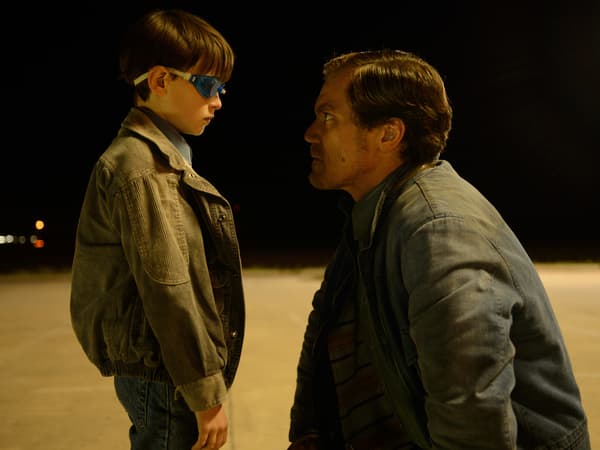
This Jeff Nichol’s film – the first of two 2016 movies directed by his long-time collaborator in which Shannon appeared – gives the audience little initial exposition. Eventually we learn that Roy grew up in the cult, and endured two years watching its leader (Sam Shepherd) raise Alton instead of him. Even before we learn this complex history, it’s all there in Shannon’s performance; how he regards his son with such guilt, fear and tenderness, but coiled fury still lurks within. When things are looking bad for an increasingly ill Alton, Roy howls, wild-eyed, “He will not die! He’s meant for something bigger!” Yet rather than being the dramatic engine he is in Wolves and Frank and Lola, he’s Midnight Special’s emotional anchor, grounding a story of cults and government agencies and supernatural powers in the pain of a traumatised father trying to make up for lost time with the son he loves but doesn’t understand.
He’s also the emotional anchor of Nocturnal Animals, though significantly less gentle. In the film’s central story-within-a-story, he’s Detective Bobby Andes, who’s in charge of finding the men who raped and killed Tony’s (Jake Gyllenhaal) wife (Isla Fisher) and daughter (Ellie Bamber). For much of his screentime, Shannon only lets Bobby’s emotion show through his eyes: filled initially with suspicion at Tony’s odd behaviour, then pity when his distress at the discovery of his family’s bodies clearly exonerates him. Once Bobby is on Tony’s side… boy, is he on his side. We learn the detective is facing a terminal lung cancer diagnosis, is estranged from his daughter, and has less than a year to live. Justice isn’t coming for Tony, so with nothing left to lose, Bobby decides to help him out.
After a stoic beginning, Nocturnal Animals offers numerous chances for the violent side of Shannon to burst through. Again it’s his ability to pair the wild with the melancholic that makes the impact. He’s helped by the part – the movie has a phenomenal cast, but the roles are largely thinly written or flatly unsympathetic, with Bobby being the most layered of all the characters. Shannon brings with him his typical gravitas. He got a well-deserved Oscar nomination for his troubles.
While his unhinged side is always fun, it’s that sadness that lingers longer. That was the presiding note of his subtly commanding performance in low-key drama Complete Unknown, where his midlife crisis-facing academic marvels wistfully at the reappearance of his dynamic, identity-shifting former girlfriend (Rachel Weisz). Surprisingly, that sadness also dominated his lead turn as Elvis Presley in Elvis and Nixon. Though the film is a comedy-drama imagining events surrounding the titular real life meeting between two historical heavyweights, much of that comedy is derived from the way others react to Elvis, rather than Shannon’s performance. That leaves him free to expand on the portrait of a man driven to isolation and delusion by living nearly his whole adult life as one of the most famous people on the planet. Which is not to downplay his comedic chops – his dry delivery of some of Presley’s ridiculous lines is consistently delightful – but it’s his unfailing ability to add texture to even the lightest of projects that makes him such an enthralling actor.
And he can do it in even the briefest of screentime, as in his second Jeff Nichols movie of 2016, Loving. In an extended cameo, he’s Grey Villet, the Life photographer who took pictures of Richard and Mildred Loving (Joel Edgerton and Ruth Negga), the couple who got the US ban on interracial marriage overturned in 1967. As we watch him watch them, he vividly becomes the audience surrogate, those eyes full of warmth at the evident love the couple share, and sadness at the unjustness that continues to face them. He’s on screen for only a few minutes, yet the strength of his quiet compassion leaves a lasting impression.
All that was just one year in Michael Shannon’s career; we didn’t even get to the never-released-in-the-UK Poor Boy, or Batman vs. Superman: Dawn of Justice (for which he didn’t film any new material, but was credited nonetheless).
Though Shannon received his first big screen credit 24 years earlier and has worked steadily since, 2016 played out like an epic, extended showreel for a monumental talent; one who could play an abusive father, a gentle photographer, and Elvis Presley with equal ease, all the while denying audiences the ability to tear their eyes from him. That momentum would burst through to the following year, where his chilling performance as the sadistic villain in Guillermo Del Toro’s The Shape of Water would be amongst the chief factors that propelled the movie to its best picture win, and has rippled through the decade since in projects such as The Little Drummer Girl and The Bikeriders. We might never see a year as bountiful for Shannon again, but his chameleonic presence has become a highlight of the cinema landscape.


0 Comments